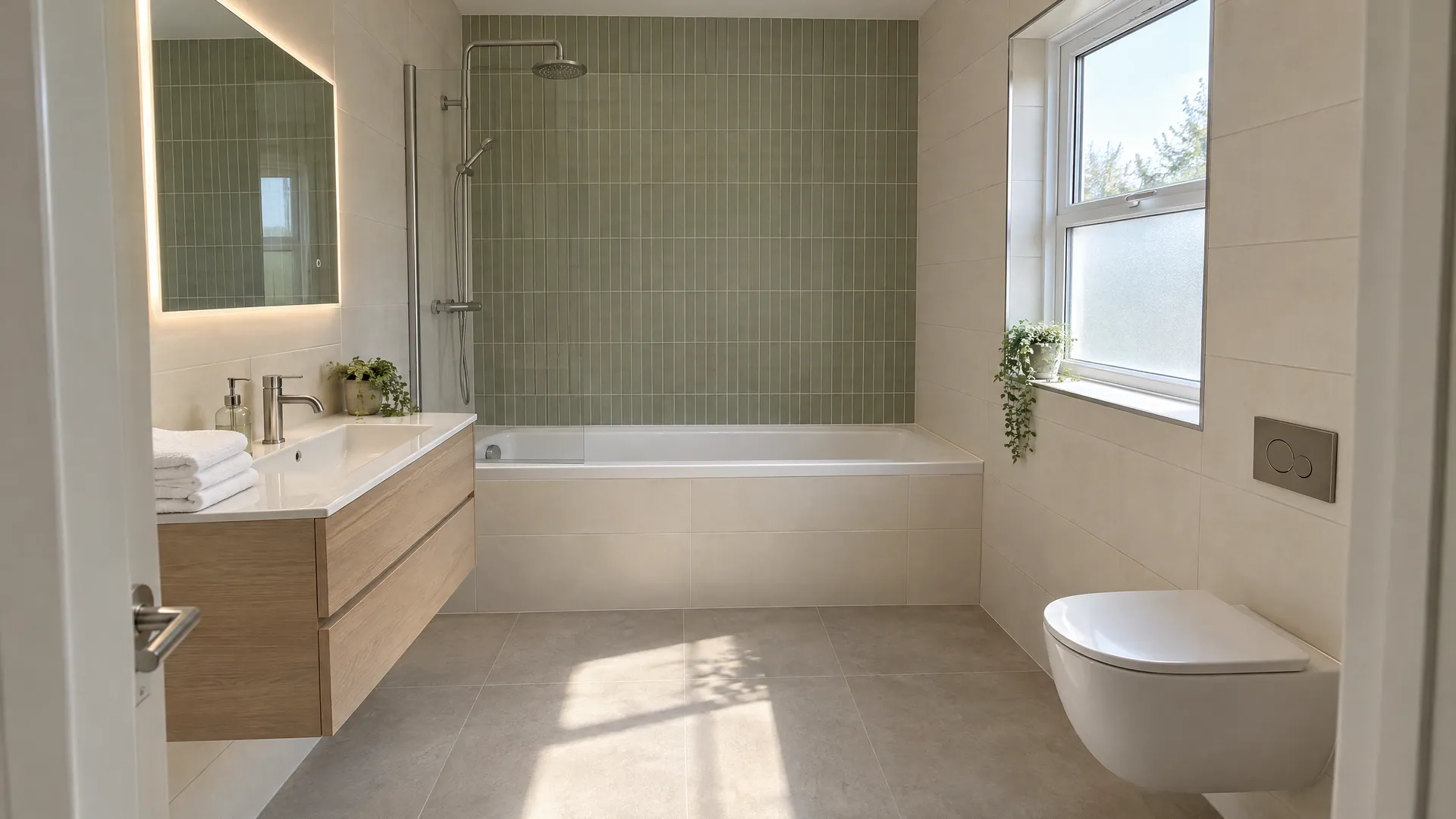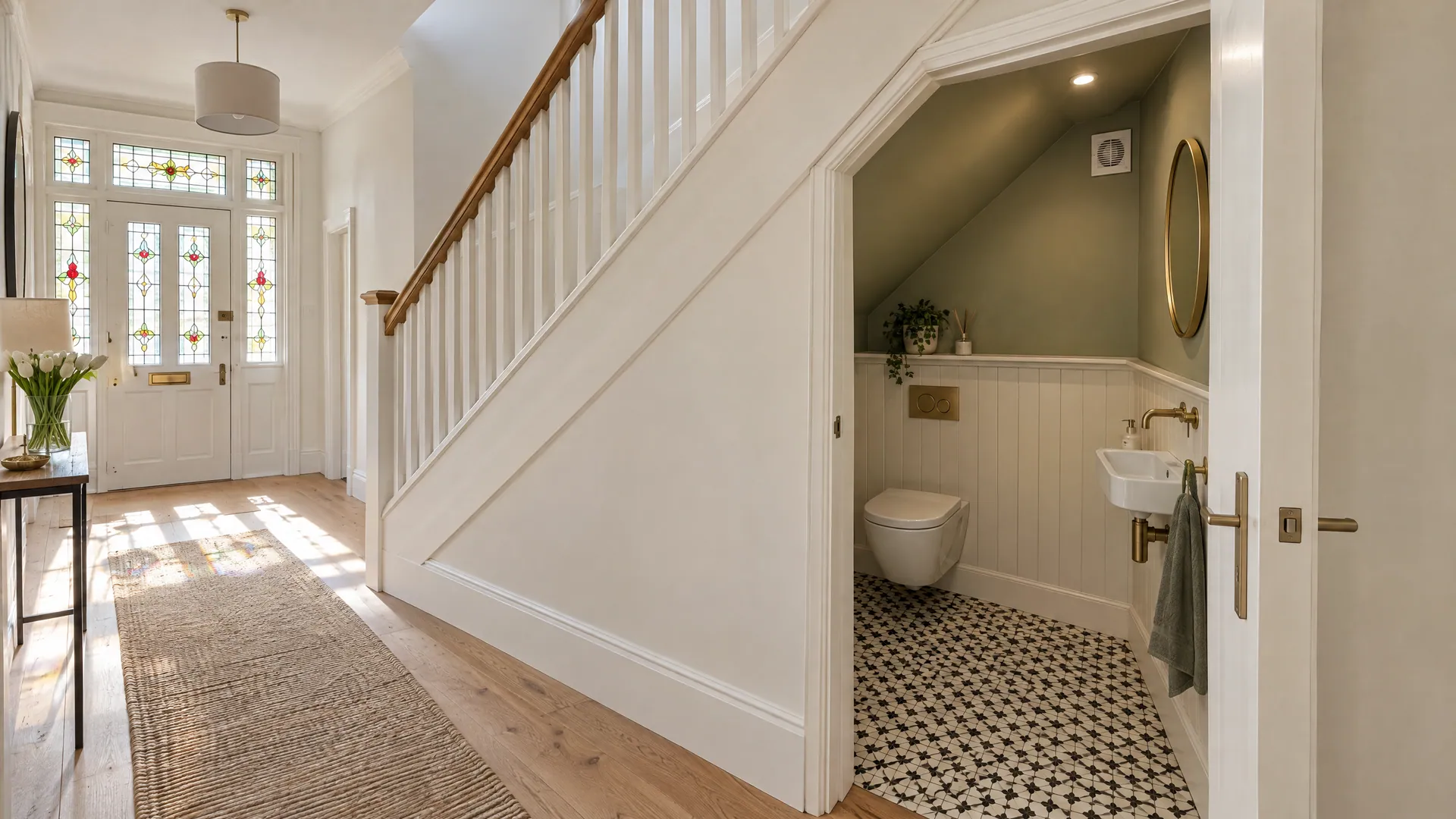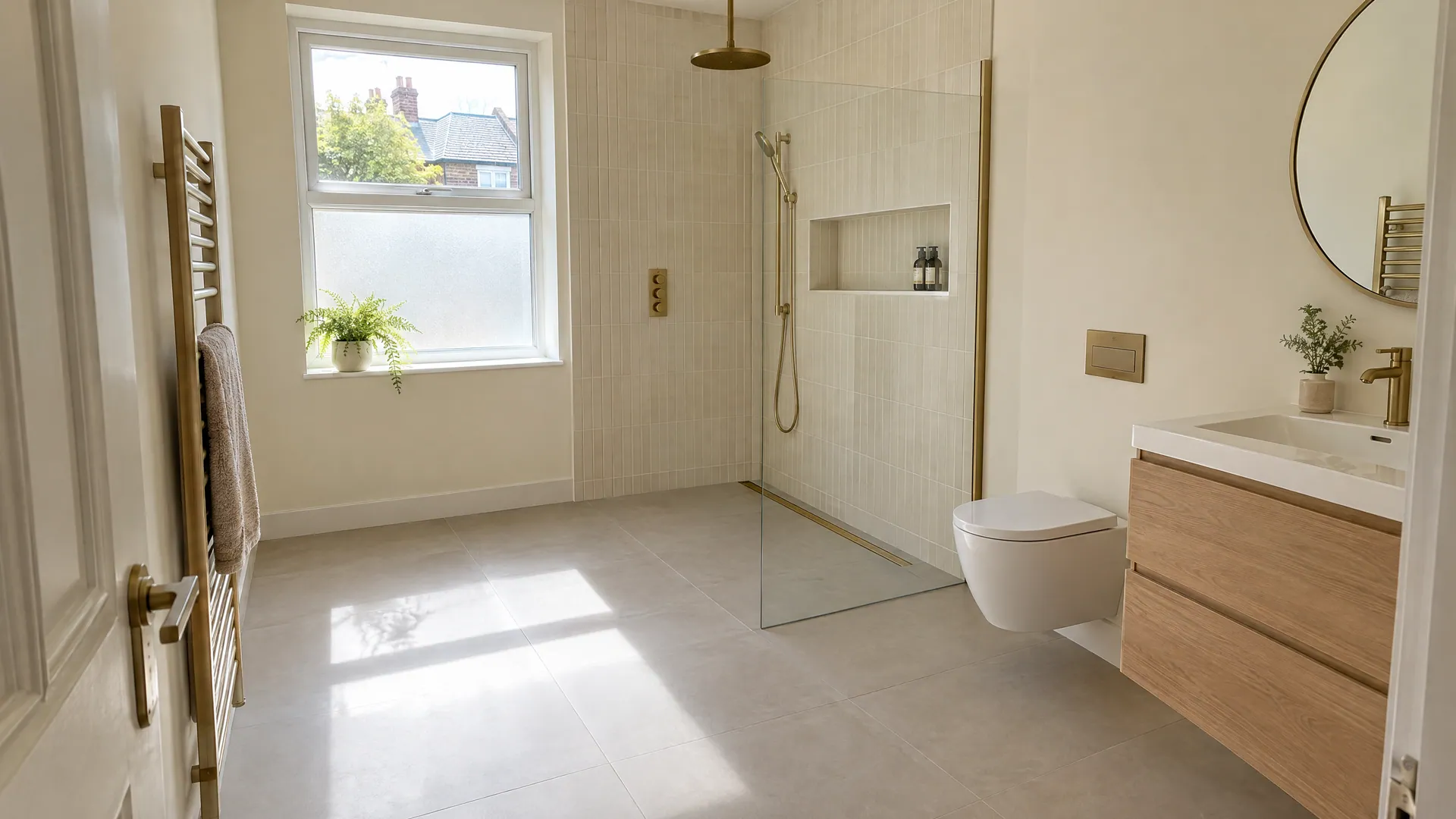
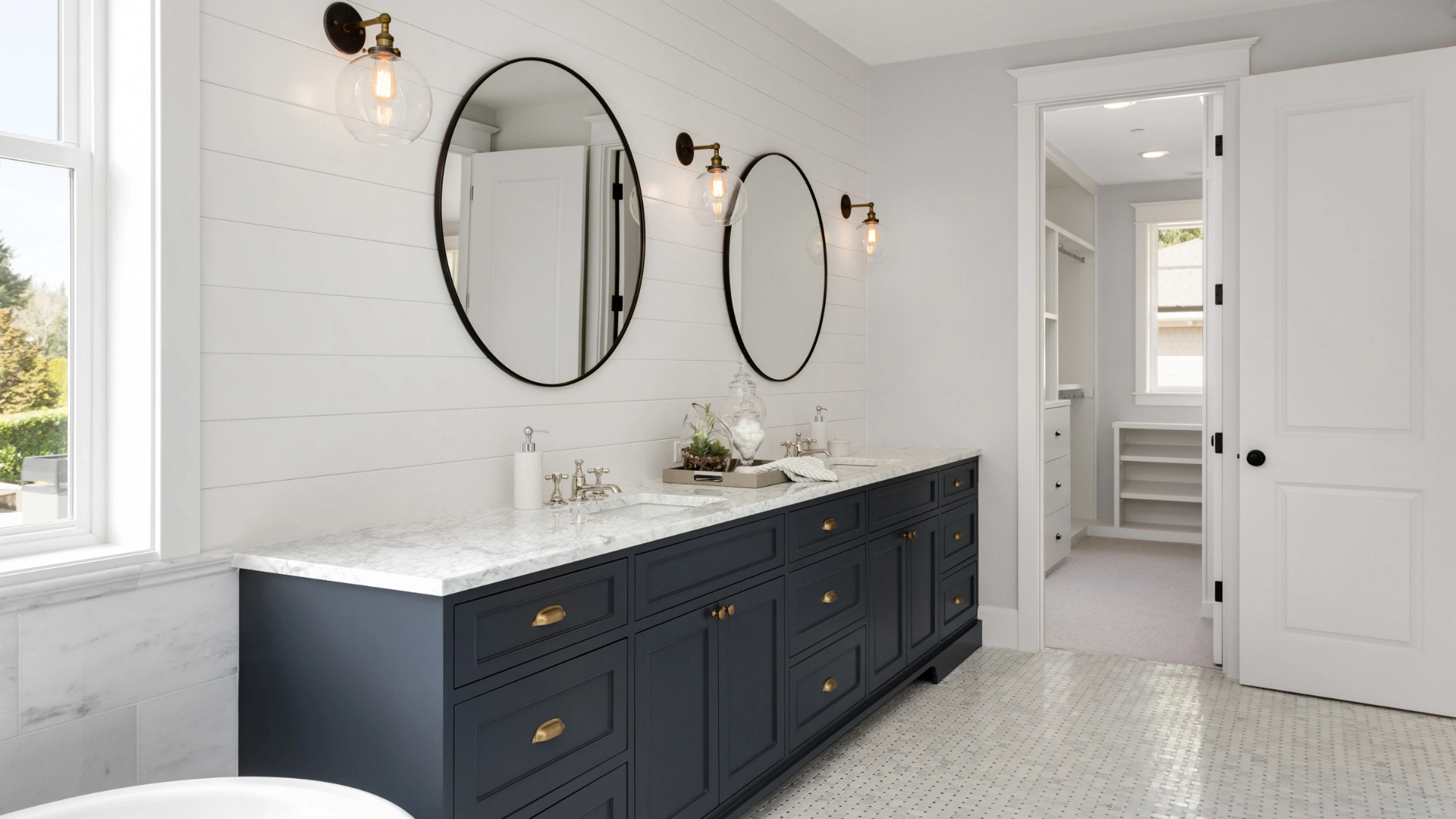

A full bathroom renovation in Ireland costs €6,000 to €11,000 in 2026 for a standard three to five square metre bathroom where the existing layout is kept. In Dublin, expect €7,000 to €13,000 for the same scope, or €9,000 to €17,000 if the toilet, shower or basin moves. A cosmetic refresh keeping the existing layout and replacing fixtures and tiles runs €4,000 to €7,000 in Dublin (€3,000 to €6,000 elsewhere).
A small ensuite costs €5,000 to €10,000 in Dublin, a wet room €12,000 to €22,000 and above, and a large bathroom with a premium finish €14,000 to €25,000 and above. The single biggest cost lever in any bathroom renovation is whether you are changing the layout. Keeping the toilet, shower, and basin in their existing positions saves €1,500 to €4,000 on plumbing and drainage alone and significantly reduces the programme. Most bathrooms take 1 to 4 weeks on site.
If you would rather have a fixed price than a range, Build Me's bathroom renovation packages are priced including VAT: Essential €9,307, Standard €14,301 and Premium €24,176, with a downstairs WC at €6,356.
Bathroom Renovation Cost Breakdown
Outside Dublin: a cosmetic refresh costs €3,000–€6,000, a full renovation keeping the layout €6,000–€11,000, a layout change €8,000–€15,000, a large premium bathroom €12,000–€22,000+, a small ensuite €4,000–€8,000 and a wet room €10,000–€20,000+. The single biggest cost lever is keeping the existing layout. Moving the toilet, shower, or basin adds €1,500–€4,000.
Sources: Build Me project data and 2026 Irish market benchmarks. All figures are for Dublin, supply and fit including VAT. Costs assume a full strip-out and fit-out unless stated as a refresh. Substrate condition, tile specification, and sanitaryware selection are the main variables within each range. Add 10–15% contingency to all figures (15–20% for pre-1980 properties). A written quote from a contractor who has visited your property is the only accurate figure for your specific bathroom.
Bathroom Renovation Calculator
Cost ranges based on 2026 Dublin and Irish market data. The ranges match our bathroom renovation calculator. Add 10–15% contingency for bathroom renovations; pre-1980 properties should budget 15–20%.
Add-ons
build cost estimate
contingency (15%)
set aside before starting
total budget
including contingency
Typical cost breakdown by trade
Cost Breakdown by Trade
Most Irish homeowners never see a proper breakdown. A total of €9,000 or €12,000 means little without knowing where it goes. This is how a standard full bathroom renovation in Dublin is typically split by trade in 2026.

Plumber
Plumbing is usually the largest labour cost. A standard same-layout job takes an RGI-registered plumber two to four days, and plumbing labour and pipework typically come to €1,200 to €2,200 in Dublin. If the layout changes, moving the toilet, shower or basin adds €1,500 to €4,000, more if the soil stack has to move.
The scope includes removing existing sanitaryware, rerouting pipework where needed, installing the shower valve, connecting basin and toilet waste, fitting towel rail pipework if required, and final commissioning. Any gas work must be completed by an RGI-registered plumber. This is a legal requirement in Ireland.
Electrician
Bathroom electrics must be carried out by a RECI-registered electrician. Irish regulations classify bathrooms as special locations, with strict rules on zones and fixture placement. A standard job runs €600 to €1,200, covering lighting, extractor fan installation ducted externally, and a shaver socket.
If the towel rail is electric, allow €150 to €250 for a dedicated circuit. A completion certificate is issued by the electrician and forms part of the property’s compliance record.
Tiler
Tiling is the most visible part of the job and typically the second largest labour cost. Standard ceramic or porcelain tiling labour costs €45 to €65 per m² in Dublin. Large format tiles (600mm x 1200mm+) cost €65 to €100 per m² to lay due to additional prep and handling.
A typical 4m² bathroom requires 20 to 28m² of tiling depending on height. Labour comes to €900 to €1,800, with tiles costing €800 to €1,500 at mid-range. Tile choice is where budgets often slip. Selecting tiles before pricing avoids underestimation.
Natural stone such as marble or limestone costs €60 to €200 per m² and requires specialist installation. This increases both material and labour costs.
Bathroom Fitter or Carpenter
This covers fitting the vanity, mirrors, shelving, doors, towel rails, and accessories. Most jobs take a bathroom fitter one to two days, at a cost of €500 to €1,000.
Bespoke joinery or built-in storage requires a carpenter, which increases both scope and cost.
Plasterer
Plastering is needed where walls are damaged during strip-out or pipework installation, or where surfaces are not suitable for tiling. A standard job takes half to one day, costing €500 to €900. In older Dublin properties with poor wall condition, expect €900 to €1,400.
Bathroom Material Costs
The cost of the suite itself varies enormously based on specification. Here is a realistic breakdown by tier for a standard bathroom (toilet, basin, shower tray or bath, shower valve and riser, heated towel rail, taps, mirror, accessories):
Sources: Build Me project data and 2026 Irish market benchmarks. Figures are for a standard 4 to 5m² bathroom renovation in Dublin, mid-spec finish, same layout, including VAT. Layout changes add €1,500–€4,000 to the plumbing line. Tiling costs vary significantly with tile format and specification; large format tiles and natural stone sit at the upper end. Add 10–15% contingency to all figures (15–20% before 1980). Outside Dublin, the same scope typically costs €6,000–€11,000.
What Affects the Cost of a Bathroom Renovation in Ireland?

Layout Changes vs Same Layout
Keeping the existing layout is the most effective way to control cost. Toilets, basins, and showers are positioned around existing soil stacks, waste runs, and supply lines. Moving them means chasing floors and walls, rerouting pipework, and often altering the soil stack.
Relocating a toilet across a standard Dublin bathroom adds €1,500 to €2,500. Moving a shower costs €600 to €1,500. Moving several fixtures typically adds €1,500 to €4,000 in total. Keeping the layout avoids these costs entirely. If the change is cosmetic, weigh the visual gain against the added spend.
Bathroom Size and Cost Per m²
Bathroom renovations in Ireland range from €1,500 to €3,200 per m² depending on specification. Smaller bathrooms cost more per m² because fixed costs do not scale with size. Plumbing, electrics, and strip-out cost roughly the same whether the space is 3m² or 6m².
A 3m² bathroom typically costs €2,400 to €3,200 per m². A 6m² bathroom at the same spec falls to €1,500 to €2,100 per m². Larger spaces benefit from scale, mainly in tiling.
Tanking and Waterproofing
Tanking is often underbudgeted but essential. It involves applying a waterproof membrane to wet areas before tiling. It typically costs €250 to €500, with labour often included in tiling.
Bathrooms without proper tanking develop water ingress within two to five years. This leads to tile failure, mould, and structural damage. In practice, the most expensive repairs come from skipped or poorly applied tanking.
Wet Room vs Standard Shower Enclosure
A wet room costs €2,000 to €5,000 more than a standard shower. The increase comes from the drain system (€300 to €800), floor screed with gradient (€400 to €900), and full floor tanking (€200 to €400). Removing the enclosure saves €300 to €800 but does not offset the added work.
Wet rooms suit accessible design, high-end finishes, or layouts that support open drainage. In smaller bathrooms, a walk-in shower with a low-profile tray achieves a similar look at lower cost.
Tile Choice and Format
Tile choice affects both materials and labour. Standard porcelain (300mm x 600mm) is the most cost-efficient. Large format tiles (600mm x 1200mm+) increase labour due to prep and handling.
Natural stone adds cost at every stage. Materials range from €60 to €200 per m² and require sealing, specialist adhesive, and experienced installation. Not all tilers are equipped for stone, so this should be confirmed early.
Underfloor Heating
Electric underfloor heating typically adds €400 to €1,200 installed, depending on floor area, insulation board and the thermostat chosen. It requires connection to the consumer unit by a RECI-registered electrician.
Running costs are low, and the comfort gain is immediate. For regularly used bathrooms, it is a practical upgrade if budget allows.
Hidden Costs Most Irish Homeowners Miss
Skip hire in Dublin costs €150 to €300. Subfloor issues, once exposed, add €300 to €800. Building a stud wall for a concealed cistern or partition costs €400 to €700. Upgrading ventilation, including ducting and a compliant fan, costs €150 to €350.
These items typically add €700 to €2,000 to a project where they were not allowed for.
How to Manage Your Bathroom Renovation Budget

Keep the Existing Layout Where Possible
Already covered in the cost drivers section, but worth repeating. The layout decision is made before you brief any contractor. Once first fix plumbing begins, changing your mind is expensive. Confirm the layout in writing before work starts.
Set Your Tile Budget Before You Start Shopping
Walk into any tile showroom without a budget and you will spend more than you planned. Decide on a per m² spend for tiles before you look at samples. Mid-spec porcelain at €20 to €40 per m² is available in genuinely beautiful formats. Tiles at €80 to €120 per m² are available and are not always noticeably better in a finished bathroom. The sweet spot for most Dublin bathrooms is €25 to €50 per m² for wall tiles and €20 to €40 per m² for floor tiles.
Order Sanitaryware and Tiles Before the Job Starts
The most common cause of a bathroom renovation stalling mid-programme is materials not being on site when the relevant trade arrives. The tiler who cannot tile because the tiles are not there is still charging for their time. Order everything with a delivery confirmed before the contractor starts on site.
Stage Payments Tied to Milestones
Pay the deposit on contract signing, a stage payment after first fix is complete and inspected, a further payment after tiling is done, and the final payment after snagging is signed off. Never pay the full contract value before the job is finished. The final payment is your only practical leverage on snagging items.
Set a 10 to 15% Contingency and Mean It
Set aside 10 to 15% of your total budget before the project starts. In a pre-1980 Dublin property, 15 to 20% is more realistic. The contingency covers substrate issues, subfloor problems, unexpected pipework conditions, and anything else the strip-out reveals. Treating it as a buffer you hope not to use rather than a fixed line in the budget is the approach that leads to budget overruns.