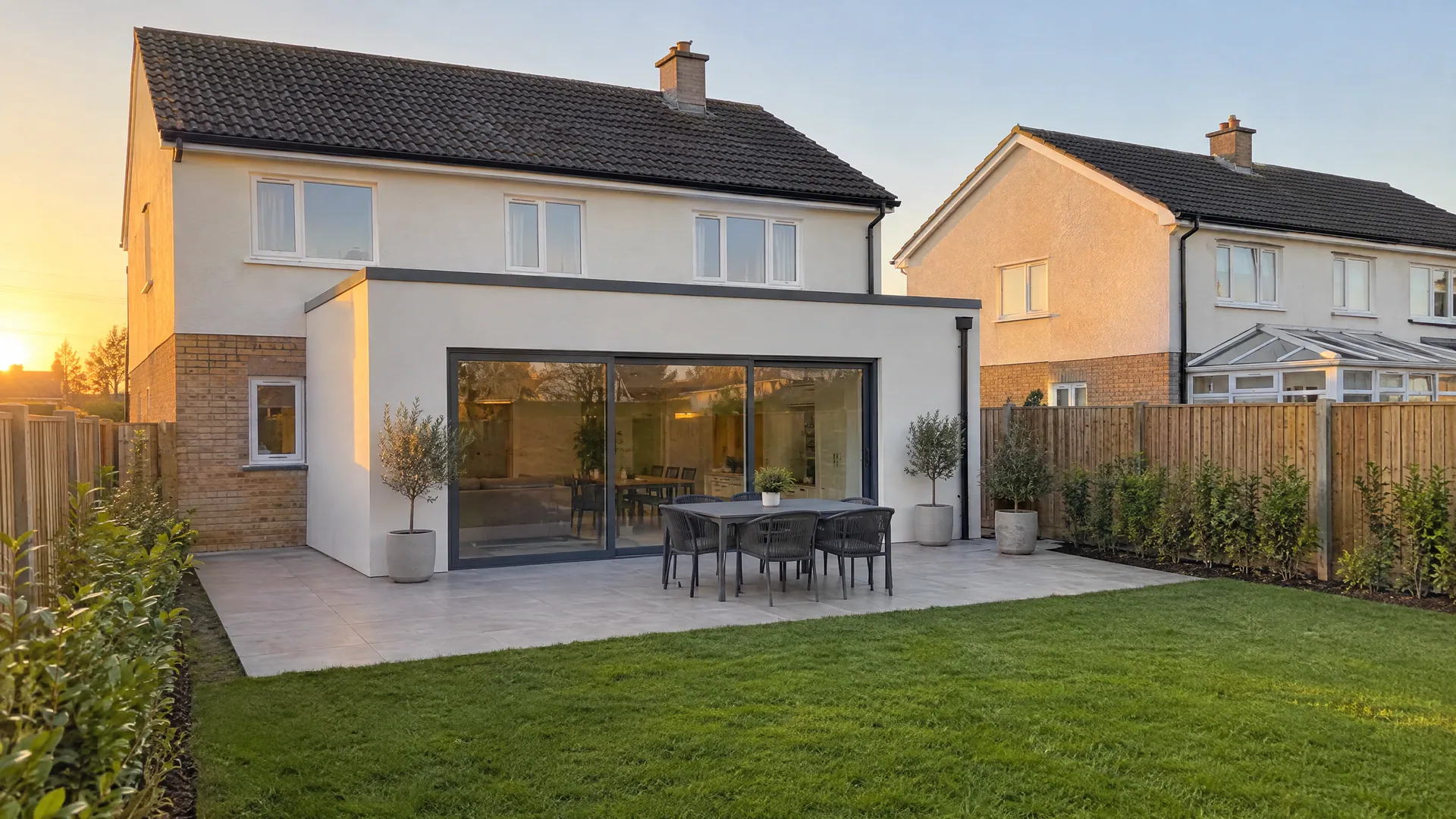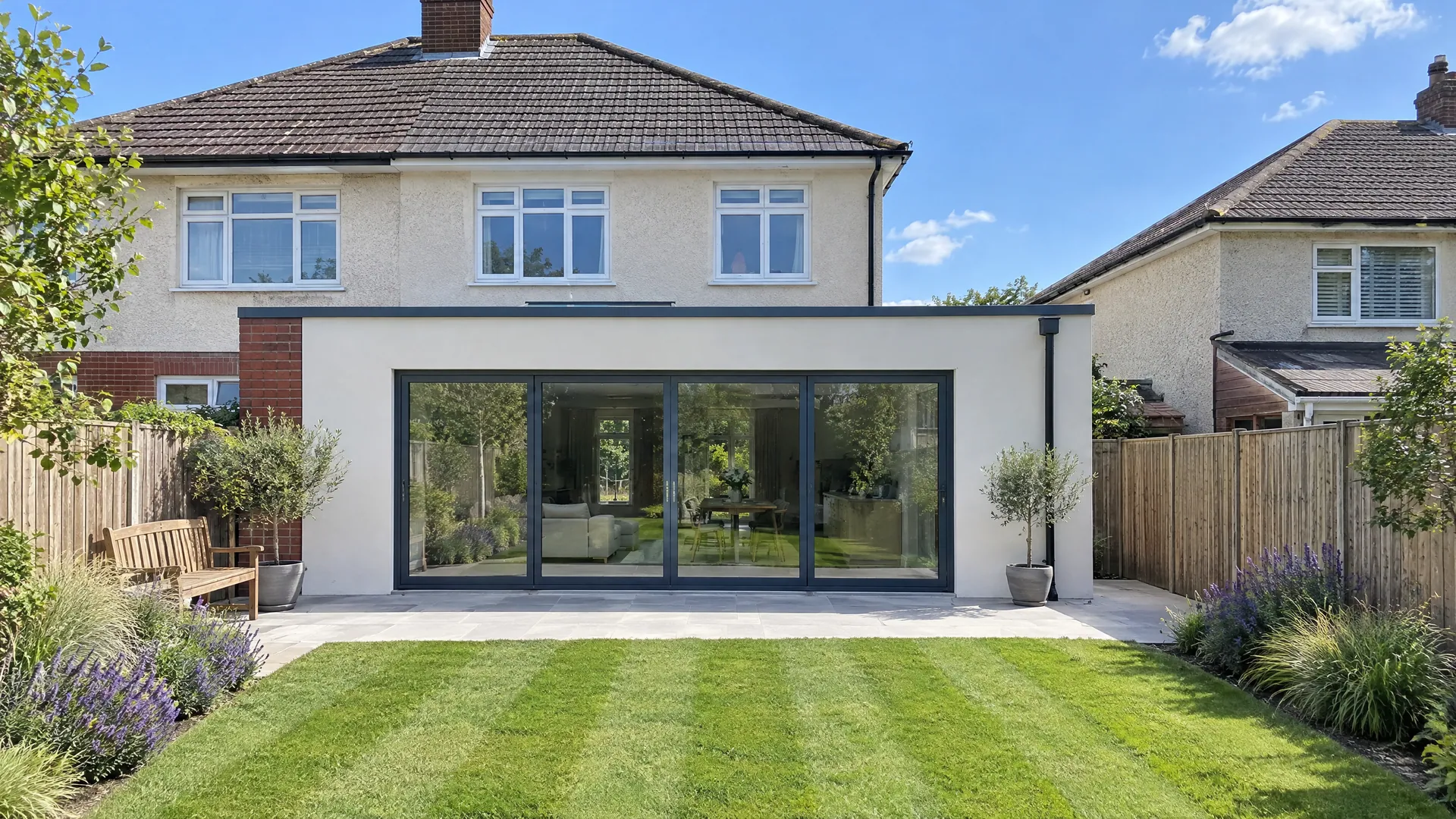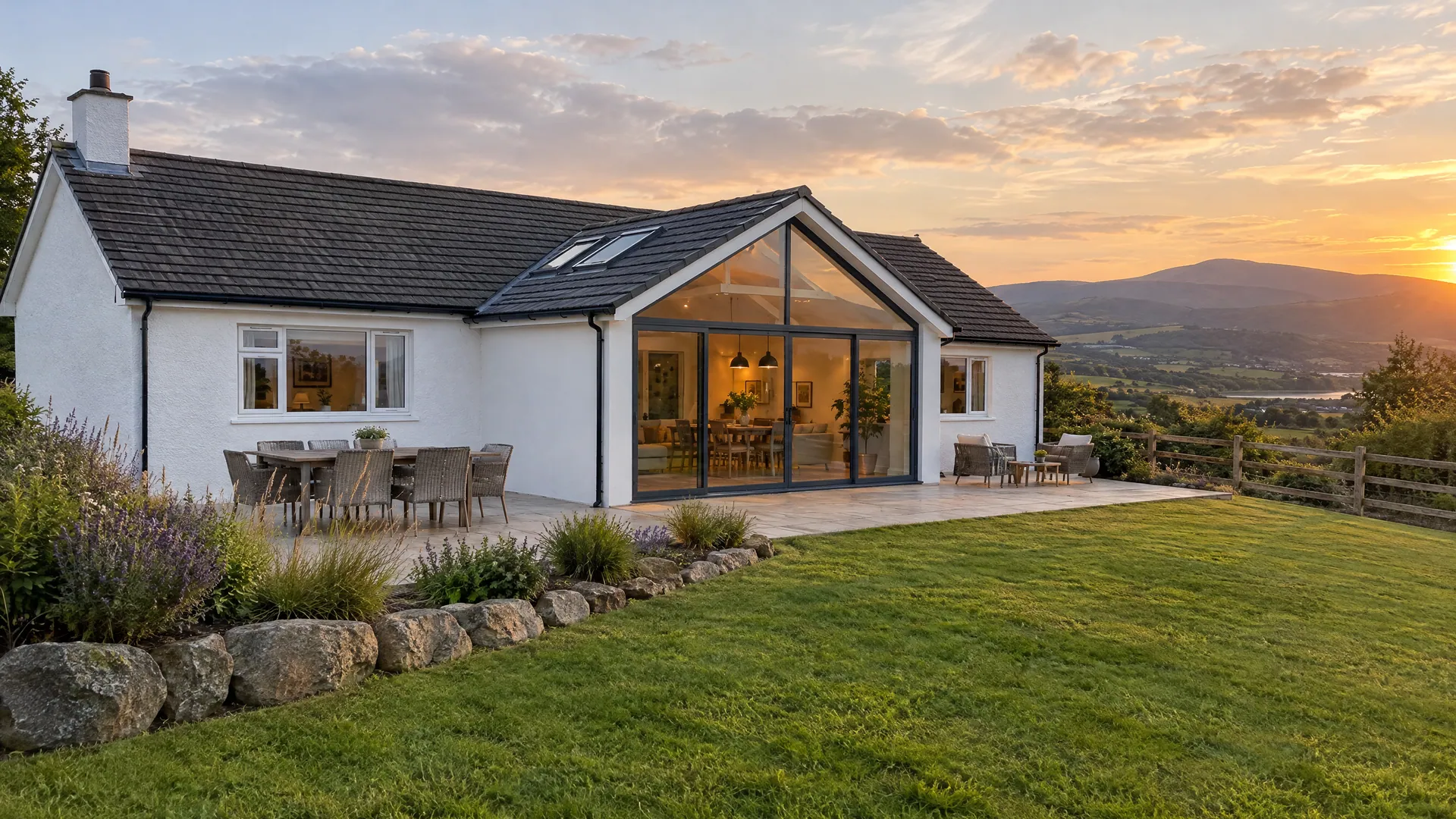
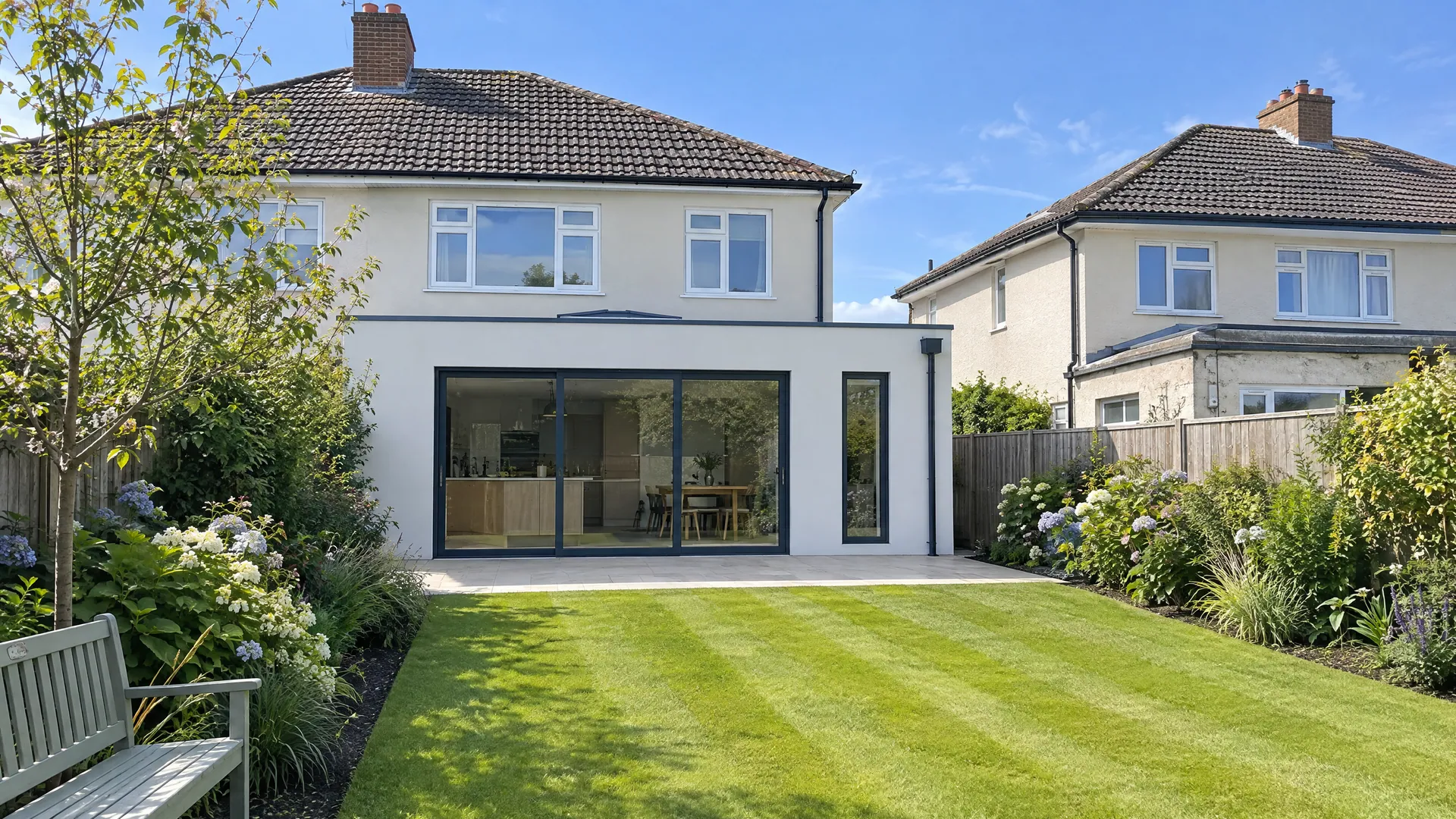

For most flat roof extensions in Ireland, EPDM rubber is the safest all-rounder. It is one seamless sheet, cold applied, with a 20-year membrane warranty. GRP fibreglass suits roofs you walk on. A certified two-layer torch-on felt system is also durable. Whichever you pick, build a warm roof with a fall to a parapet outlet.
Here is the surprising part. The waterproof layer is one of the cheapest parts of the extension. A complete EPDM roof kit costs about €45 per m² in Ireland, according to Rubber for Roofs (2026). The extension itself costs €2,700 to €3,400 per m² in Dublin. So the covering is under 2% of the build. What really decides whether a flat roof leaks is the build-up, the falls and the details around rooflights and outlets.
EPDM, GRP or Felt: How Do They Compare?
The table sets the three main coverings side by side, plus liquid and PVC single-ply. Lifespans come from manufacturer certificates and suppliers, so treat them as a guide to a well-fitted roof. A poorly fitted roof of any type can fail within a few winters.
| Factor | EPDM rubber | GRP fibreglass | Torch-on felt (2 or 3 layer) | Liquid / PVC single-ply |
|---|---|---|---|---|
| Typical lifespan | 20-year warranty, 50-year expectancy claimed | 25 years minimum (BBA-certified system) | Over 35 years (BBA-certified system) | 25 to 30 years (certified liquid systems) |
| Materials cost | About €38 to €45 per m² as a full kit | About €14.50 per m² for mat and resin, plus topcoat and trims | About €8.50 per m² per layer, plus cap sheet | Varies; mostly specialist installers |
| Relative installed cost (Build Me estimate) | Medium | Medium to high | Low to medium | High |
| Joints | Often none: one sheet | None once cured | Overlapping 1 m wide rolls | Liquid: none; PVC: welded seams |
| Look | Matte black | Smooth, usually grey, can be coloured | Mineral chippings in a few colours | Smooth, light grey or white |
| Foot traffic | Light, maintenance only | Good, regular foot traffic | Good with a mineral cap | Good with walkway pads |
| Weather to install | Cold applied, dry deck | Dry only, above 7.5°C | Dry deck, naked flame | Dry, temperature limits apply |
| Repairs | Patch with primer and cover tape | Grind back and re-laminate | Torch on a patch | Recoat over the area |
Sources: Rubber for Roofs (2026); Roofnstop.ie prices (October 2026); BBA certificates 91/2604, 10/4744 and 14/5158 via NBS Source and LRWA; CrysticROOF FAQ. Relative installed cost is a Build Me estimate.
What Is Each Flat Roof Covering?
All three main coverings go on top of the same structure. On a block-built extension, that is usually timber joists, a timber deck, a vapour control layer and insulation boards. The covering is the last layer, and each type is laid in a different way.
EPDM Rubber Roof
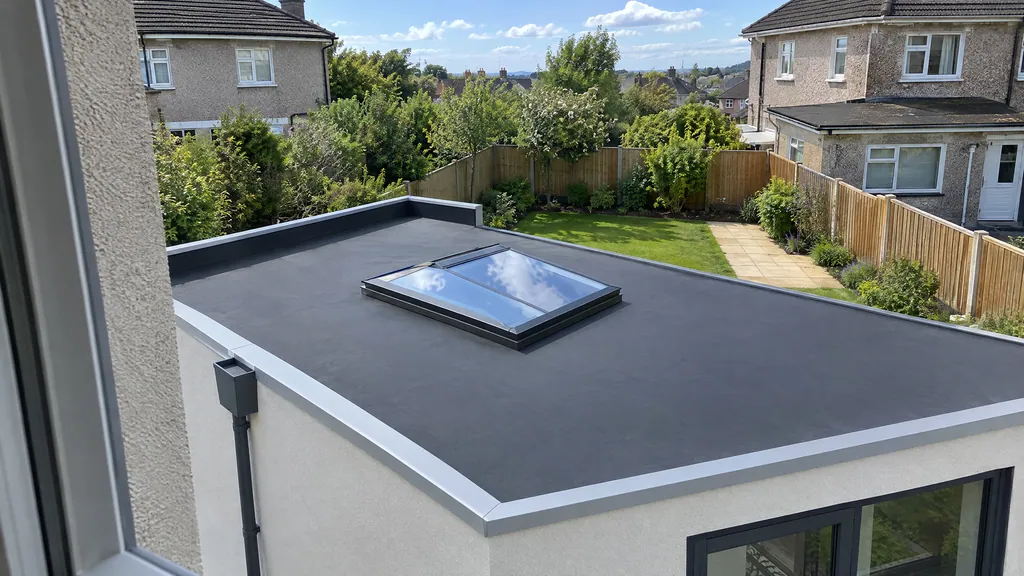
EPDM is a synthetic rubber sheet, bonded to the deck with adhesive. Irish suppliers cut it from wide rolls. Rubber for Roofs stocks nine roll widths, from 3.05 m up to 12.2 m. That means most extension roofs get one single piece, with no joints across the deck.
It is cold applied, so there is no flame on site. PVC kerb trims, a gutter or drip trim and a metal trim at the house wall finish the edges. Rubber for Roofs gives a 20-year membrane warranty and quotes a 50-year life expectancy. The EPDM Roofing Association (March 2026) reported that well-fitted EPDM routinely lasts at least 38 years.
- One seamless sheet on most extension roofs
- No naked flame during fitting
- Easy to patch with primer and cover tape
- Matte black only, which some find plain
- Softer surface, not for regular foot traffic
- Edges and trims need careful detailing
GRP Fibreglass Roof
GRP is glass reinforced polyester. The roofer lays chopped strand glass mat on an OSB deck and wets it out with resin. A coloured topcoat goes on once the laminate cures. Pre-formed GRP trims handle the edges, so the roof becomes one hard, seamless shell.
It is tough underfoot. The Polyroof 185 GRP system holds BBA certificate 91/2604, with a minimum durability of 25 years. Its listing says it takes regular foot traffic without extra protection. The catch is the weather. Scott Bader's CrysticROOF guidance says to lay GRP only in dry conditions and never below 7.5°C. In an Irish winter, that can mean waiting for a dry window.
- Hard, seamless finish that takes foot traffic
- Topcoat comes in grey and other colours
- Moulds neatly around kerbs and upstands
- Needs dry weather above 7.5°C to lay
- Quality depends heavily on the laminator
- Can crack if the deck moves or flexes
Torch-On Felt Roof
Modern torch-on felt is a polymer-modified bitumen membrane with a polyester reinforcement. It is not the thin shed felt of the 1980s. A proper system has two or three layers, melted onto each other with a gas torch. The top layer is a cap sheet faced with mineral chippings for UV protection.
Quality varies more than with any other covering. Bauder's two-layer torch-applied warm roof system has a BBA-stated service life of over 35 years (certificate 10/4744). At the other end, Rubber for Roofs says cheap felt can need replacing in 3 to 5 years. The difference is the product, the number of layers and the roofer.
- Lowest materials cost per m²
- Certified multi-layer systems last decades
- Mineral cap takes foot traffic well
- Naked flame on site, near timber and the house
- Many overlapping seams on 1 m wide rolls
- Cheap single-layer felt fails quickly
Liquid and PVC Single-Ply Roofs
Liquid roofing is a resin, often polyurethane, rolled on with a reinforcing fleece. It cures into a seamless skin and wraps tricky details well. Sika's Decothane Ultra 25 and 30 Year systems hold BBA certificate 14/5158 for at least 25 and 30 years. PVC single-ply is a thin plastic sheet with hot-air welded seams, common on commercial roofs. Both work on homes. Specialist installers price them higher, so they suit complex or high-spec roofs best.
How Long Does Each Flat Roof Last?
Lifespan is the question most homeowners ask first. The chart shows the durability each certified system or supplier states. These are not like-for-like tests, so read them as the life of a good system, fitted well.
In practice, the covering rarely fails first. Most leaks start at a detail. Think outlets, rooflight kerbs, the house wall junction or a lapped seam. That is why EPDM's single-sheet fit and GRP's seamless shell score well on Irish extensions. It is also why a cheap felt roof with many seams fails fastest.
Most system guarantees only hold when an approved installer fits the roof to the certificate. Ask your builder which system they use, who fits it and what guarantee you get in writing.
How Much Does a Flat Roof Extension Cost per m²?
Start with the whole build. Build Me prices a single-storey rear extension at €2,700 to €3,400 per m² in Dublin (October 2026). That covers foundations, block walls, the roof structure, insulation, the covering, glazing and finishes. A 20 m² single-storey rear extension in Dublin comes to €54,000 to €69,000.
The covering itself is a small line. The table shows Irish merchant prices for materials only, checked on 25 October 2026. Labour, the deck, insulation, trims and outlets come on top. All of them sit inside the per m² rates of our extension cost calculator.
| Covering | Irish merchant price | Works out at | What it leaves out |
|---|---|---|---|
| EPDM full kit, 3 m × 6 m roof | About €815 (Rubber for Roofs) | About €45 per m² | Deck, insulation, outlet, labour |
| EPDM full kit, 6 m × 6 m roof | About €1,350 (Rubber for Roofs) | About €38 per m² | Deck, insulation, outlet, labour |
| GRP: 600 g mat plus resin | Mat €172.20 per 55 m² roll; resin €167.28 per 20 kg, inc VAT (Roofnstop) | About €14.50 per m² | Topcoat, trims, OSB deck, labour |
| Torch-on 4 mm membrane | €67.65 per 8 m² roll, inc VAT (Roofnstop) | About €8.50 per m² per layer | Second layer, mineral cap, labour |
| Single-storey rear extension, whole build | Build Me pricing, Dublin | €2,700 to €3,400 per m² | Kitchen, fees, contingency |
Prices checked 25 October 2026. GRP figure uses Roofnstop's stated resin ratio of 2.25 times the glass weight. Rubber for Roofs kit prices include membrane, adhesives, trims and fixings.
By comparison, a felt roof needs fewer euro of material but more seams and more skilled torching time. GRP needs a dry spell and a careful laminator. EPDM sits in the middle on price and is quick to lay on a dry day. On a typical 20 m² roof, the gap between coverings is a few hundred euro of material, not thousands.
Which Looks Best on a Modern Flat Roof Extension?
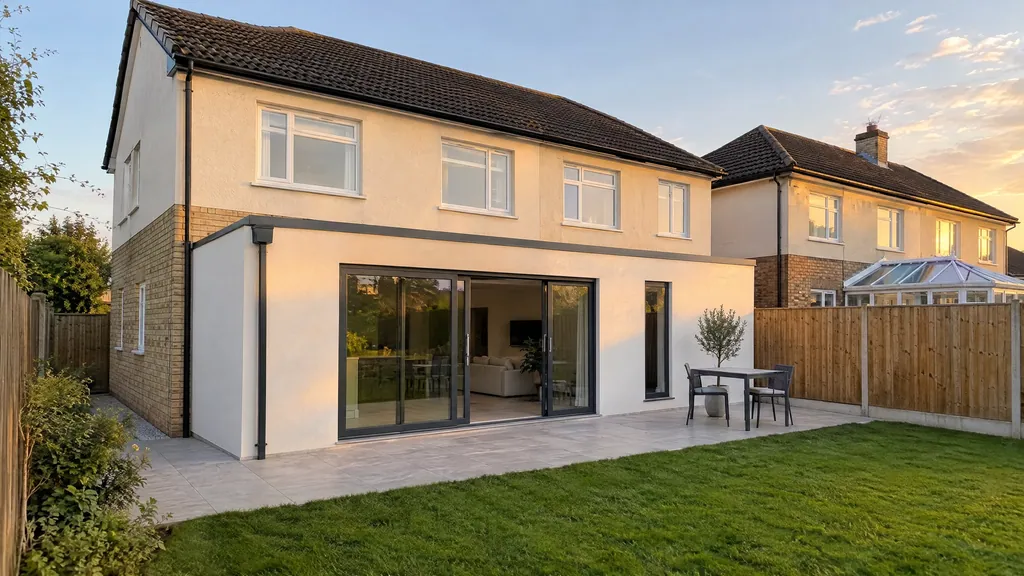
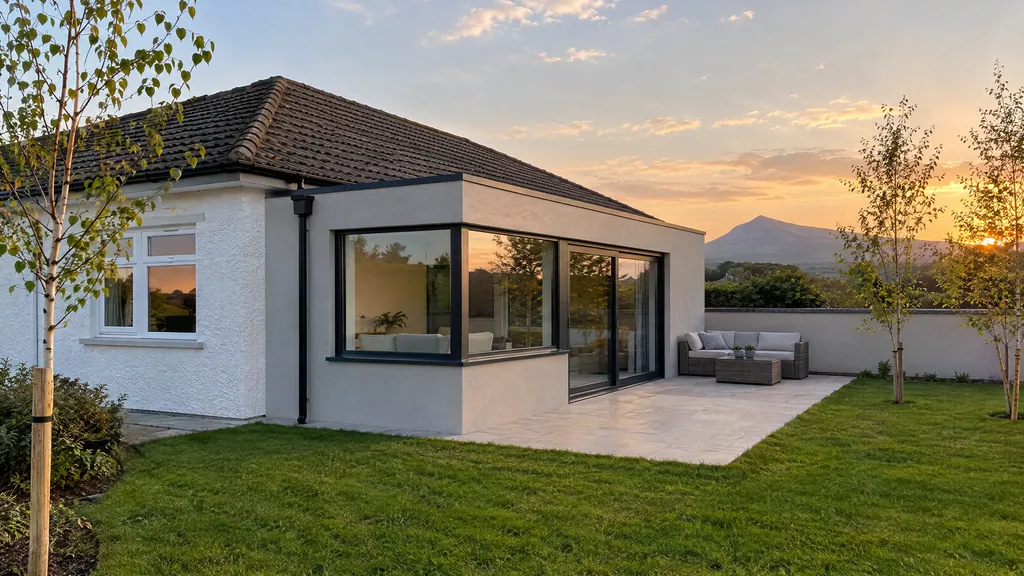
On most modern flat roof extensions, you never see the covering from the garden. A low parapet with a slim aluminium coping hides it. That clean box with a crisp parapet line is the look most people want. It suits 1930s semis, 1990s brick semis and bungalows alike.
The covering matters when you look down on it from upstairs. EPDM is matte black. GRP is smooth and usually dark or light grey. Torch-on cap sheets carry slate chippings, and Viapol's Unisol range comes in a choice of colours. If the roof sits under a bedroom window, pick a finish you are happy to see every morning.
Which Flat Roof Is Easiest to Repair and Walk On?
Every flat roof gets a knock at some point. A dropped tool, a slipped ladder or a branch can puncture it. How easily it repairs matters as much as how long it lasts.
| Covering | How a puncture is repaired | Ease of repair |
|---|---|---|
| EPDM | Clean, prime and apply an EPDM cover tape patch | Easy, a small job on a dry day |
| GRP | Grind back, lay new mat and resin, then topcoat | Moderate; the colour may not match exactly |
| Torch-on felt | Torch a new patch of cap sheet over the damage | Easy, but repeated patches signal old felt |
| Liquid | Clean and recoat over the area | Easiest of all |
General repair methods for each covering. Always use the system maker's approved repair products.
Foot traffic is a separate question. GRP and mineral-capped felt take regular walking best. EPDM handles maintenance visits, such as cleaning a lantern, but it is softer. Under the 2026 exempted development regulations, an exempt flat roof cannot be a balcony or terrace. A roof terrace needs planning permission, plus a guarding and a covering rated for it.
Which Works Best With Rooflights and Lanterns?
Most flat roof extensions have at least one opening. It might be a flat glass rooflight, a walk-on panel or a raised lantern. Each one sits on an upstand, or kerb, and that kerb is where leaks love to start.
EPDM wraps up a kerb in one piece, with pre-formed corners. GRP is laminated up the kerb as part of the same shell. That makes it strong for roofs with several openings. Torch-on needs extra pieces cut and lapped around each corner. Liquid systems handle awkward shapes best of all. Under Technical Guidance Document L (2022), rooflights in an extension need a U-value of 1.4 W/m²K or better.
| Opening | Example price (Roofnstop, plus VAT) | Best for |
|---|---|---|
| Flat glass rooflight, 600 × 600 mm | From €700 (Skylux iWindow 2) | Small extensions, utility rooms |
| Flat glass rooflight, 900 × 900 mm | €850 (Skylux iWindow 2) | Kitchen and dining areas |
| Roof lantern, 1500 × 1000 mm | €2,200 (Brett Martin Horizon) | Over an island or table |
| Roof lantern, 3000 × 2000 mm | €4,500 (Brett Martin Horizon) | Deep open-plan rooms |
Supply only, prices checked 25 October 2026. Fitting, the kerb and the roof around it come on top.
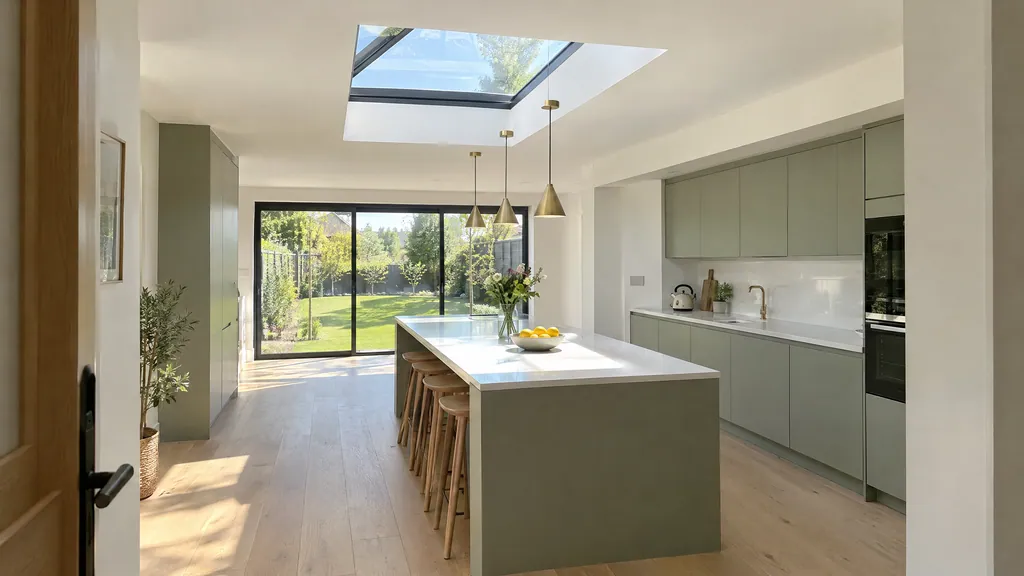
Height is the other catch. A lantern stands up above the roof line. On a two-storey house, that rarely matters for planning. On a bungalow, where the eaves are low, a tall lantern could push the roof above the exempt height. Check this before you order one.
Warm Roof or Cold Roof: Which Build-Up Do You Need?
A warm roof puts the insulation on top of the deck, under the covering. A cold roof puts it between the joists, with a ventilated gap above. For a flat roof extension against an Irish house, a warm roof is almost always the right answer.
Here is why. Technical Guidance Document F (2019) sets the rules. A cold flat roof needs vents on two opposite sides and a 50 mm air gap. Where the roof edge abuts a wall, so air cannot cross freely, it says another construction should be used. A rear extension against the house, often with parapets, is exactly that case. Warm deck roofs need no ventilation, according to the same document.
| Layer (top to bottom) | Warm roof | Cold roof |
|---|---|---|
| Covering | EPDM, GRP, felt or liquid | EPDM, GRP, felt or liquid |
| Insulation | Rigid boards on top of the deck | Between the joists, below a 50 mm vented gap |
| Vapour control layer | On the deck, under the insulation | At ceiling level, on the warm side |
| Ventilation | None needed | Cross-ventilation on two opposite sides |
| Condensation risk | Low when detailed well | Higher, especially against a wall or parapet |
| Roof depth | Deeper: insulation sits above the joists | Shallower overall |
Source: Technical Guidance Document F, Ventilation (2019), paragraphs 2.1.5 and 2.1.14 to 2.1.19.
How Much Insulation Does Part L Need?
Building Regulations apply even when planning permission does not. Under Technical Guidance Document L (2022), an extension's flat roof needs an average U-value of 0.20 W/m²K. Windows, doors and rooflights need 1.4 W/m²K.
In a warm roof, that typically means around 120 to 150 mm of PIR insulation board (Build Me estimate). Your designer's U-value calculation sets the exact figure. A few extra millimetres also go on firrings or tapered boards to form the fall. The result is a deeper roof edge than many people expect. On a bungalow, that depth matters for planning height, as the section below explains.
How Should a Flat Roof Extension Drain?
A "flat" roof is never truly flat. Standard practice in Ireland and the UK follows BS 6229. Designing Buildings Wiki explains that flat roofs are usually designed to a 1:40 fall. That aims for at least 1:80 once the roof is built and has settled. Without it, water ponds, and ponding shortens the life of every covering.
The neatest drainage for a parapet roof is a single outlet through the parapet wall. It feeds a hopper and one downpipe to the drain. This keeps the walls clean, with no gutter on show.
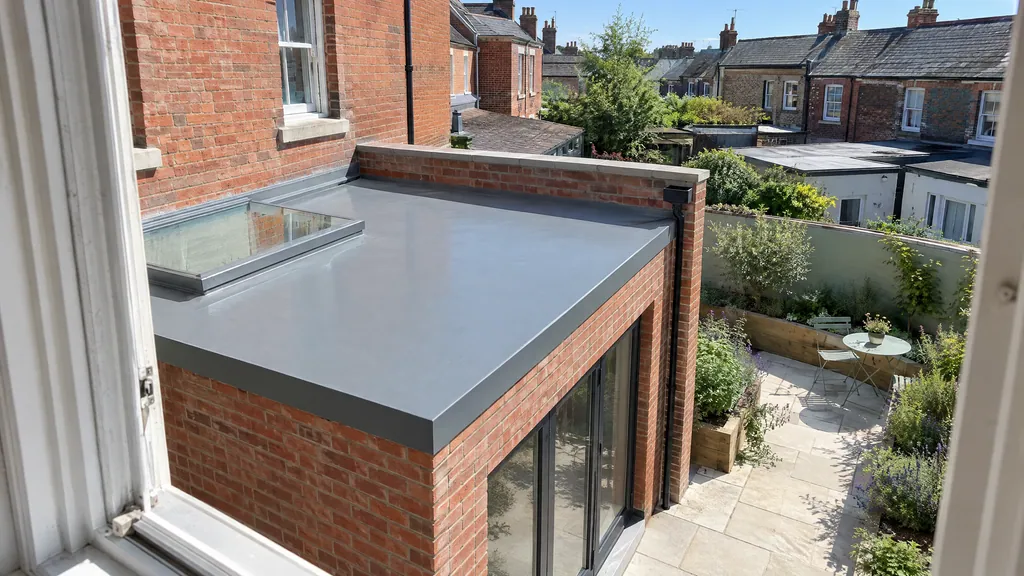
- Fall: designed at about 1:40, so the finished roof is at least 1:80, with no back falls towards the house.
- Outlet: one parapet outlet at the low corner, sized for the roof area, sealed into the covering.
- Downpipe: one hopper and downpipe into the surface water drain or soakaway, never onto the patio.
- Overflow: a small overflow through the parapet, so a blocked outlet shows up before water gets inside.
- House wall: the covering turned up the wall at least 150 mm and protected by a flashing or trim.
- Maintenance: clear the outlet of leaves every autumn, especially near trees.
Do You Need Planning Permission for a Flat Roof Extension?
Usually not, if it is at the rear. Under the 2026 exempted development regulations (S.I. 338 to 344 of 2026), Class 1 covers rear extensions up to 45 m² in total, up from 40 m². That total counts every extension built since 1 October 1964. At least 25 m² of private open space must remain.
The rule that matters most for flat roofs is height. A flat roof cannot rise above the eaves or parapet of the house. The walls cannot be higher than the house's rear wall. Ground-floor windows must be at least 1 m from the boundary they face. Side and front extensions need full planning permission for an extension, typically 12 to 16 weeks from drawings to a decision.
The eaves are high, so a single-storey flat roof sits well below them. Watch the 45 m² total and the garden space.
A tall lantern or thick insulation raises the roof line. Confirm it stays under the limit before ordering.
Low eaves leave little room for joists, insulation and falls. Plan the ceiling height and floor level carefully.
Flat Roof Extension on a Bungalow
A flat roof extension on a bungalow is where the height rule bites. Bungalow eaves are low. The extension's roof, including joists, insulation and the fall, must stay at or below them to be exempt. A deep warm roof can squeeze the ceiling height inside.
There are a few ways around it. Shallower, stronger joists or steel can save depth. Dropping the extension floor a step lower adds headroom. A mono-pitch roof is another option. Class 1 lets a pitched roof rise to the highest part of the house roof. It is one of the most practical bungalow extension ideas for low eaves. If you are unsure, a Section 5 declaration from your council costs €80 and normally takes about 4 weeks.
Which Flat Roof Should You Choose?
There is no single winner. The right covering depends on your roof's shape, how you will use it and when it gets built. Here is how the choice usually falls out.
- A simple rear box with one lantern: EPDM. One sheet, no flame, easy to patch, and it lasts.
- You need to walk on it for maintenance often: GRP, or torch-on with a mineral cap.
- Lots of rooflights, kerbs and awkward corners: GRP or a liquid system, which wrap details in one skin.
- A winter build with no dry spell in sight: EPDM, since GRP needs dry weather above 7.5°C.
- You want the lowest material spend: a certified two-layer torch-on system from an approved installer, not single-layer shed felt.
- A bungalow with low eaves: any covering works. Focus on a slim warm roof that stays under the height limit.
- A high-spec roof or a future green roof: a certified liquid or single-ply system, specified by your designer.
Whatever you pick, the covering is only as good as the deck, falls and details under it. A well-built single-storey extension gets those right from the start. Build Me builds house extensions in traditional block construction across Dublin and north Wicklow.
Tell us about your house and garden. We will talk you through the roof build-up, rooflights, drainage and the 45 m² planning limit. Then we give you a clear quote.
FAQ
What is the best roof for a flat roof extension in Ireland?
For most rear extensions, EPDM rubber is the best all-rounder. It goes on as one seamless sheet with no flame and comes with a 20-year membrane warranty from Irish suppliers. GRP is better if you will walk on the roof often.
Is EPDM better than torch-on felt?
EPDM has fewer joints and needs no naked flame, so it is simpler to fit well. A certified two-layer torch-on system can last just as long, with BBA-stated lives of over 35 years. Cheap single-layer felt is the one to avoid.
How long does a fibreglass flat roof last?
A BBA-certified GRP system, such as Polyroof 185, has a minimum durability of 25 years. It must be laid in dry weather above 7.5°C, and its life depends heavily on the laminator's skill.
Do I need planning permission for a flat roof extension?
Not usually for a rear extension up to 45 m² in total under the 2026 exempted development regulations. The flat roof must not rise above the eaves or parapet of the house. It cannot be used as a balcony or terrace.
What fall does a flat roof extension need?
Flat roofs are usually designed to a fall of about 1:40, so the finished roof achieves at least 1:80. The water runs to an outlet, often through the parapet into a hopper and one downpipe.
Should a flat roof extension be a warm roof or a cold roof?
A warm roof, in almost every case. Technical Guidance Document F says a cold roof against a wall cannot be cross-ventilated properly. Another construction should be used. A warm roof needs no ventilation.
How thick is the insulation in a flat roof extension?
Part L asks for an average U-value of 0.20 W/m²K for an extension's flat roof. In a warm roof, that typically means 120 to 150 mm of PIR board (Build Me estimate). A U-value calculation confirms it.
Sources
- Planning and Development (Exempted Development (Act of 2000)) Regulations 2026, S.I. 338 of 2026 (in force 27 July 2026).
- South Dublin County Council, New Exemptions 27.07.26 (July 2026, accessed 25 October 2026).
- Department of Housing, Local Government and Heritage, Technical Guidance Document L, Conservation of Fuel and Energy, Dwellings (2022), Table 1 and paragraph 2.1.2.1.
- Department of Housing, Local Government and Heritage, Technical Guidance Document F, Ventilation (2019), paragraphs 2.1.3 to 2.1.19.
- Rubber for Roofs, How Much Does an EPDM Roof Cost in Ireland? (accessed 25 October 2026).
- Rubber for Roofs, EPDM Membrane: roll widths, 20-year warranty and life expectancy (accessed 25 October 2026).
- Rubber for Roofs, EPDM vs Torch-On Felt (accessed 25 October 2026).
- EPDM Roofing Association, New Survey and Research Confirm EPDM Roof Membranes Last At Least 38 Years (18 March 2026).
- NBS Source, Polyroof 185 GRP System, BBA certificate 91/2604 (accessed 25 October 2026).
- NBS Source, Bauder Total Warm Roof System, torch-applied, BBA certificate 10/4744 (accessed 25 October 2026).
- LRWA Product Register, Sika Decothane Ultra 25 and 30 Year Roof Waterproofing Systems, BBA 14/5158 (issued 12 April 2022, accessed 25 October 2026).
- Scott Bader, CrysticROOF FAQ (accessed 25 October 2026).
- Roofnstop.ie, Viapol Unisol 4mm torch-on membrane (price checked 25 October 2026).
- Roofnstop.ie, 600g chopped strand mat roll, 55.11 m² (price checked 25 October 2026).
- Roofnstop.ie, Fibreglass roofing resin, 20 kg (price checked 25 October 2026).
- Roofnstop.ie, Skylux flat roof windows (prices checked 25 October 2026).
- Roofnstop.ie, Brett Martin Horizon roof lanterns (prices checked 25 October 2026).
- Designing Buildings Wiki, Flat roof (accessed 25 October 2026).
- Build Me Construction, single-storey extension pricing, Dublin (October 2026).