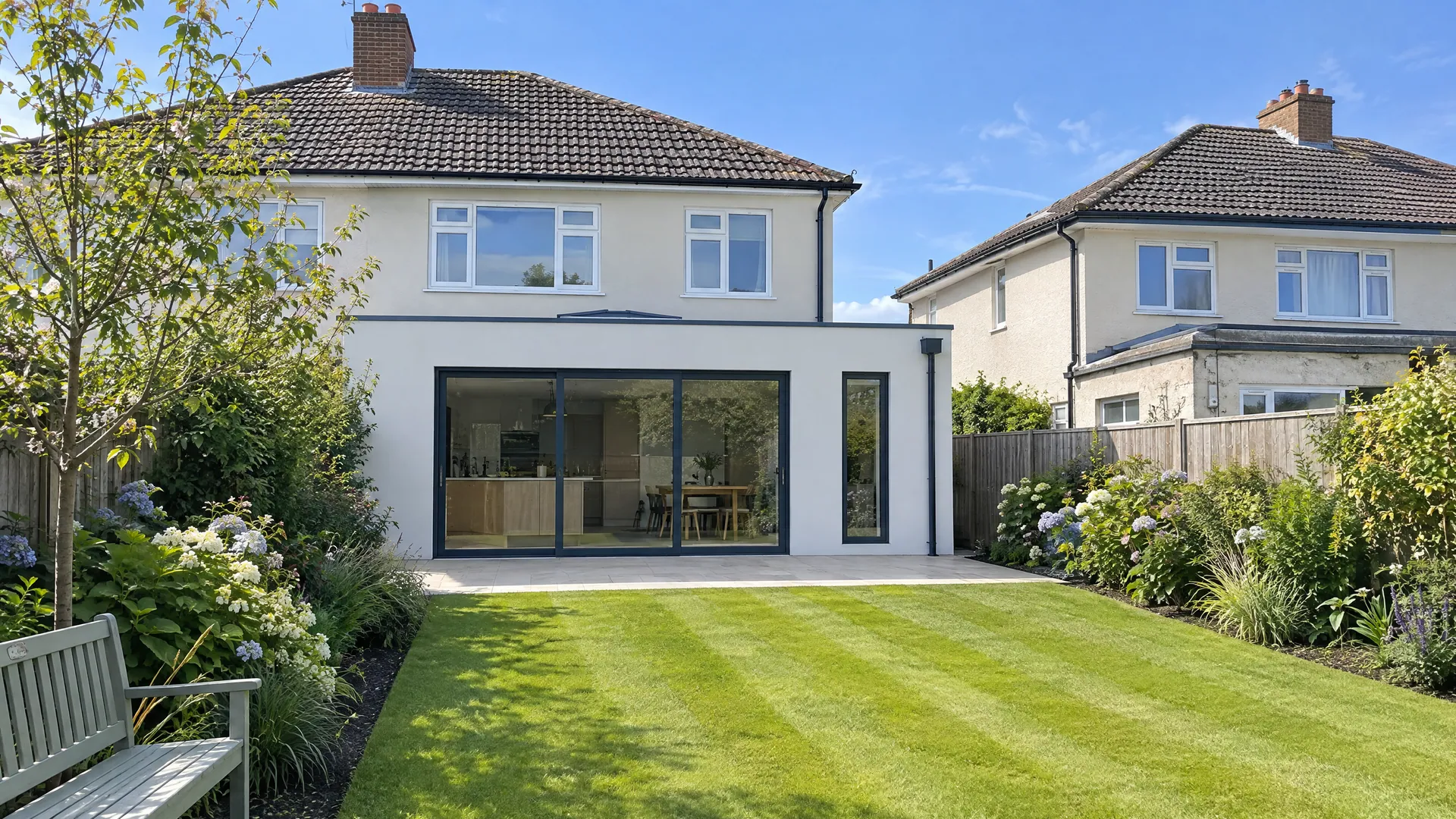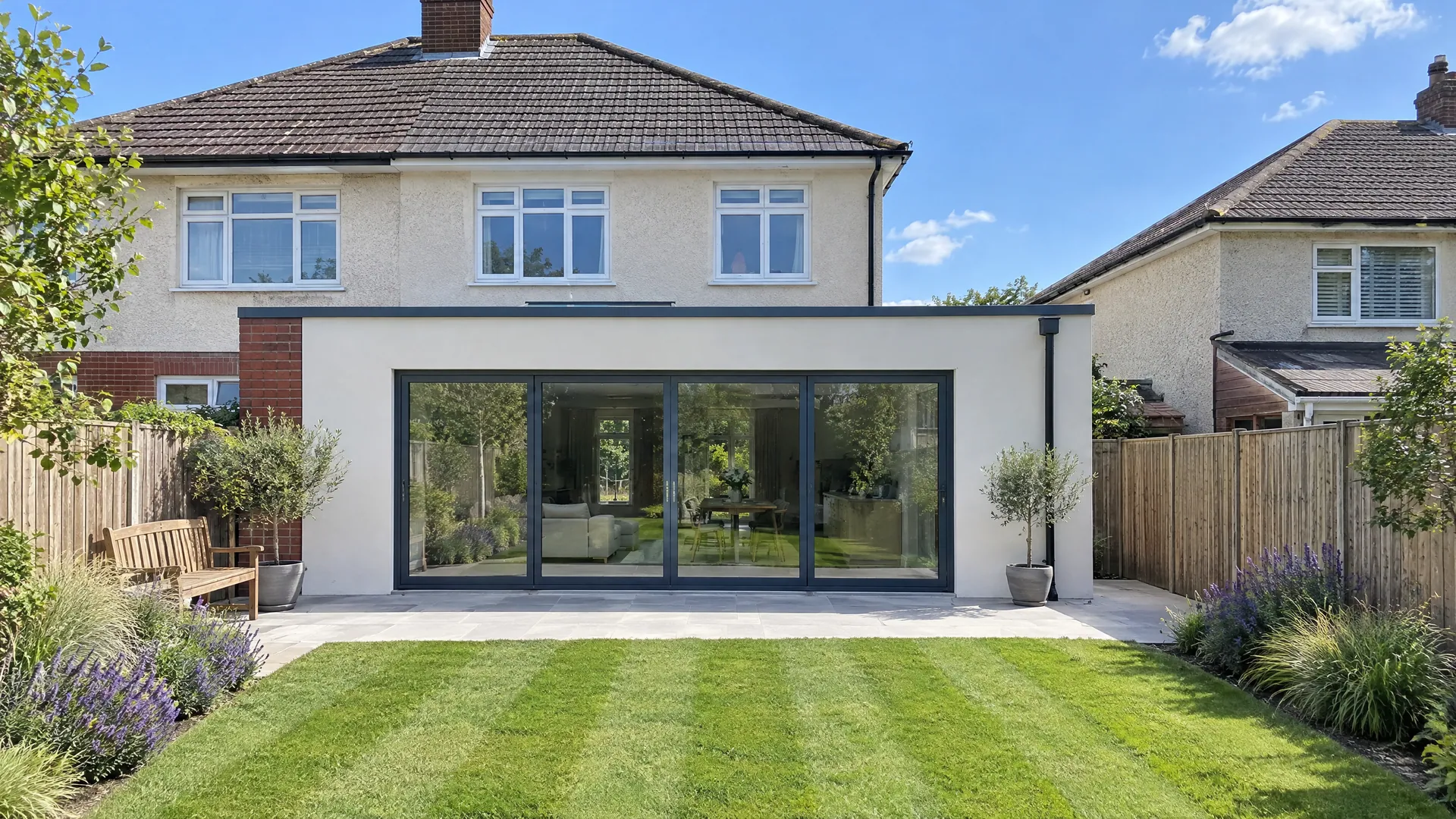
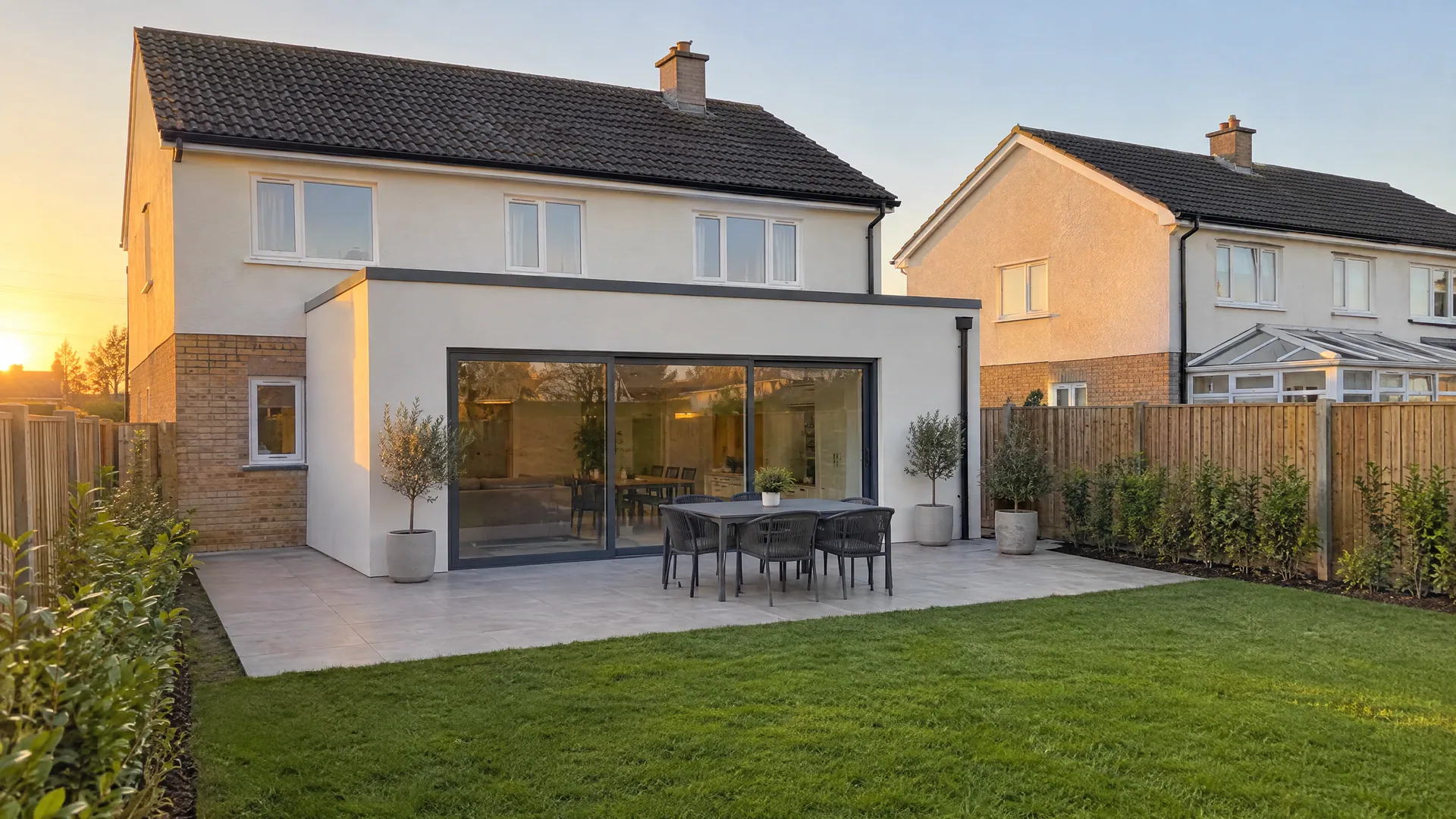

For most Dublin families, extending is cheaper than moving. Trading a typical 3-bed semi (€635,000) for a 4-bed costs about €29,400 in fees, stamp duty and removals. On top comes a price gap of €240,000 or more. A 30 m² single-storey extension with a new kitchen costs €116,000 to €170,000 all in (Build Me estimate, 2026).
Finding the bigger house is the other problem. On 1 September 2026, just under 13,800 second-hand homes were for sale nationwide, says the Daft.ie Q3 2026 Sales Report. That is about half the pre-pandemic norm of over 26,000. So the 4-bed you want, on the road you like, may simply not be for sale.
Is It Cheaper to Extend or Move in Dublin?
Here is the short version for a typical Dublin 3-bed semi in October 2026. The table compares moving up to a 4-bed semi with building a 30 m² single-storey rear extension. Every figure is explained, sourced and dated further down.
| Factor | Move up to a 4-bed semi | Extend your 3-bed semi |
|---|---|---|
| Money you never get back | About €29,400 in fees, stamp duty and removals | Professional fees of €8,100 to €12,240 |
| Total cash outlay | About €269,400 (price gap plus costs) | €116,250 to €169,540 with a new kitchen |
| Extra space | One more bedroom, usually a bigger garden or living area | 30 m² of new kitchen, living and dining space |
| Planning | None needed | Exempt up to 45 m² at the rear, under the 2026 rules |
| Time | Depends on finding a house and on the chain | 12 to 16 weeks on site |
| Schools and neighbours | May change | Stay the same |
| Disruption | A few weeks of packing and moving | Three to four months of building work at home |
Sources: Daft.ie Sales Reports Q1 and Q3 2026, Revenue, CCPC, Land Registration (Fees) Order 2012, Build Me estimates for Dublin, incl. VAT. Checked 25 October 2026.
The pattern is clear. Moving up costs roughly 1.6 to 2.3 times as much cash as extending. Most of that extra cash is the higher price of the bigger house, which you keep as equity. The fees and taxes, though, are gone the day you close.
How Much More Does a 4-Bed Cost Than a 3-Bed in Dublin?
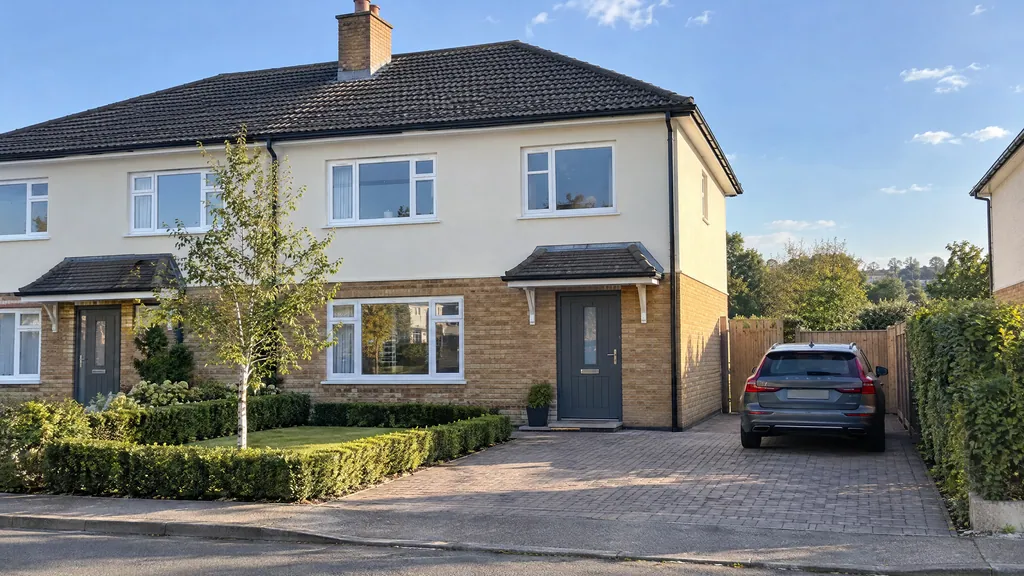
The biggest number in any extend or move sum is the price gap to the next house up. The Daft.ie Q3 2026 Sales Report, published on 28 September 2026, puts the average Dublin 3-bed semi at €635,000. That is up from €626,000 in the Q1 2026 report.
The step up to a fourth bedroom is steep. Daft.ie's Q1 2026 report put 4-bed semis €242,000 to €299,000 above 3-bed semis in the same part of Dublin. We use the lower gap, €240,000, in our worked example. That gives a 4-bed semi at about €875,000.
| Area or measure | 3-bed semi | 4-bed semi | Gap |
|---|---|---|---|
| Dublin City Centre (Daft.ie Q1 2026) | €574,000 | €873,000 | €299,000 |
| South County Dublin (Daft.ie Q1 2026) | €734,000 | €976,000 | €242,000 |
| Dublin average (Daft.ie Q3 2026) | €635,000 | About €875,000 (Build Me calculation) | €240,000 |
Sources: Daft.ie Sales Report Q1 2026 (average list prices, as published by Herbert Lansdowne Estate Agents, 2 April 2026) and Daft.ie Sales Report Q3 2026 (28 September 2026). The 4-bed Dublin average is a Build Me calculation using the lower Q1 gap.
Prices are still rising, but more slowly. The CSO Residential Property Price Index for August 2026 shows Dublin prices up 3.9% in a year. Dublin house prices rose 3.3%. Daft.ie also found that homes nationally now sell for 2.6% above asking, down from 6.8% a year earlier. So buyers have a little more room to negotiate than in 2025.
What Does It Cost to Move House in Ireland in 2026?
Moving costs fall into three groups: selling your house, buying the new one and the move itself. None of this money adds space or value. In our worked example it comes to €29,411.
Selling Costs: Estate Agent, Solicitor and BER
The estate agent is the largest selling cost. The Competition and Consumer Protection Commission (CCPC) says fees range from 1% to 2.5% of the sale price, plus VAT. VAT on these services is 23%, according to Revenue's current VAT rates. At 1.5% on a €635,000 house, the fee is €11,716 including VAT.
The CCPC also notes that advertising is often paid up front. You need a Building Energy Rating (BER) certificate before you list the house, too. Your solicitor's fee for the sale is usually €1,500 to €2,500 plus VAT, based on bonkers.ie's guide to conveyancing costs.
Buying Costs: Stamp Duty, Legal Fees and Registration
Stamp duty is charged at 1% on the first €1 million of a residential purchase, according to Revenue. The rate is 2% from €1 million to €1.5 million, and 6% above that. These rates apply to deeds signed since 2 October 2024 and were still current on 25 October 2026. On an €875,000 house, stamp duty is €8,750.
The Land Registry charges €800 to register a purchase over €400,000 and €175 to register a mortgage. Those fees are set by the Land Registration (Fees) Order 2012. A lender valuation costs around €150, according to bonkers.ie. Add your own solicitor for the purchase, searches and a structural survey.
| Moving cost | Worked example | Source |
|---|---|---|
| Estate agent fee, 1.5% of €635,000 plus 23% VAT | €11,716 | CCPC (1% to 2.5% plus VAT); Revenue VAT rates |
| Advertising and photos | €500 | Build Me estimate |
| Solicitor for the sale, €2,000 plus VAT | €2,460 | bonkers.ie range; Build Me midpoint |
| BER certificate to list the house | €250 | Build Me estimate |
| Stamp duty, 1% of €875,000 | €8,750 | Revenue |
| Solicitor for the purchase, €2,000 plus VAT | €2,460 | bonkers.ie range; Build Me midpoint |
| Land Registry: transfer €800, mortgage €175 | €975 | S.I. 380 of 2012 |
| Searches and other outlays | €200 | Build Me estimate |
| Lender valuation | €150 | bonkers.ie |
| Structural survey | €450 | Build Me estimate |
| Removals, 3-bed house within Dublin | €1,500 | Build Me estimate |
| Total moving costs | €29,411 | Build Me calculation |
Checked 25 October 2026. Estimates are typical Dublin quotes; get your own written quotes before you decide.
Costs That Are Easy to Miss
Some costs do not show up until you are mid-move. If your mortgage is on a fixed rate, your lender may charge a break fee to end it early. Ask for the exact figure in writing. A broken chain can mean short-term rent or storage between sale and purchase.
Then there are the settling-in jobs. New curtains, flooring, painting and small repairs follow most moves. Many buyers also plan a kitchen or bathroom upgrade in the new house within a few years. None of these are in our €29,411 total, so treat that figure as a floor, not a ceiling.
Breaking a fixed-rate mortgage early can add a fee that changes the whole sum. Ask your lender for the exact break cost, and whether you can port the rate to the new house.
How Much Does a Single-Storey Extension Cost in Dublin?
A single-storey rear extension in Dublin costs €2,700 to €3,400 per m² at a standard finish, including VAT at 13.5%. That is the build cost only. On top, budget 10% to 12% for professional fees and a 15% contingency. These are Build Me estimates for 2026, taken from our extension cost calculator.
| Size | Build cost | Fees, 10% to 12% | Contingency, 15% | Total before kitchen |
|---|---|---|---|---|
| 20 m² | €54,000 to €69,000 | €5,400 to €8,280 | €8,100 to €10,350 | €67,500 to €87,630 |
| 30 m² | €81,000 to €102,000 | €8,100 to €12,240 | €12,150 to €15,300 | €101,250 to €129,540 |
| 40 m² | €108,000 to €138,000 | €10,800 to €16,560 | €16,200 to €20,700 | €135,000 to €175,260 |
Source: Build Me estimates, Dublin, standard finish, incl. VAT at 13.5%, October 2026. Minimum project costs apply to smaller extensions.
Most extensions of this size include a new kitchen. A supply and fit kitchen typically costs €15,000 to €40,000 (Build Me estimate). That brings our 30 m² example to €116,250 to €169,540 all in. Structural steel for a wide opening adds €3,000 to €8,000 where the design needs it.
In practice, the size you choose drives the budget more than anything else. Our guide to extension cost by size shows how the price changes from 15 m² up to 45 m². The per m² rate falls slightly as the extension grows. Fixed costs, such as drainage connections, are spread wider.
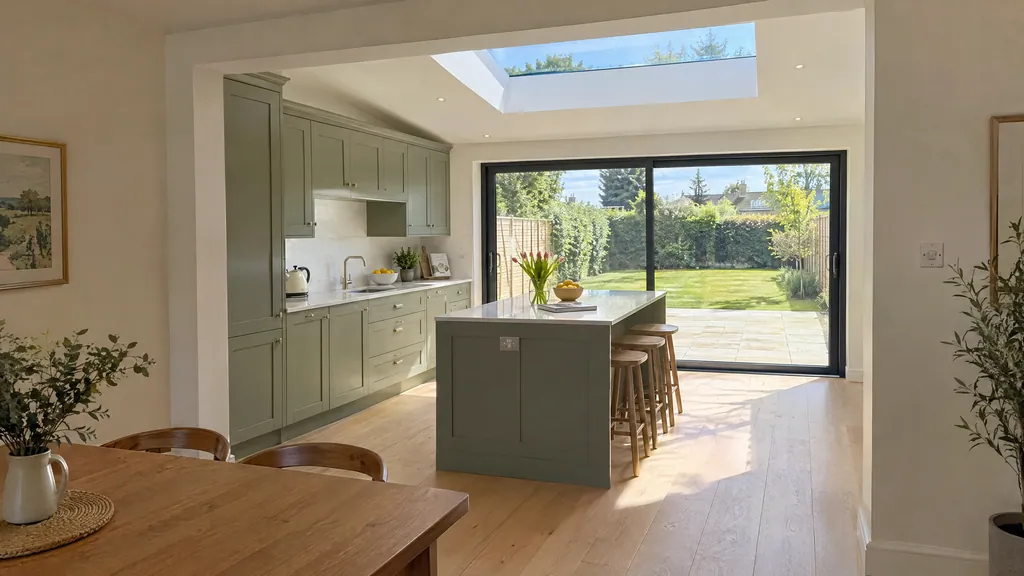
If you are weighing up a house extension in Dublin, the build itself is usually the quick part. Design, drawings and a tender take a few weeks before work starts. A single-storey extension then takes 12 to 16 weeks on site (Build Me estimate).
Extend or Move Calculator: Compare Your Own Numbers
Put in your own house value and the price of the house you would buy. The calculator applies Revenue's stamp duty bands, the Land Registry fee scale and the CCPC estate agent fee range. On the extension side it uses Build Me's Dublin rates for a single-storey rear extension.
Dublin figures, incl. VAT. Rates and fees checked 25 October 2026.
Extending costs about €99,871 to €153,161 less than moving up, before any change in property values.
| Item | Cost |
|---|---|
| Estate agent fee, 1.5% plus 23% VAT | €11,716 |
| Advertising and photos | €500 |
| Solicitor for the sale, incl. VAT | €2,460 |
| BER certificate to list the house | €250 |
| Stamp duty on the new home | €8,750 |
| Solicitor for the purchase, incl. VAT | €2,460 |
| Land Registry fees (transfer and mortgage) | €975 |
| Searches and other outlays | €200 |
| Lender valuation | €150 |
| Structural survey | €450 |
| Removals | €1,500 |
| Moving costs you never get back | €29,411 |
| Price gap to the bigger home | €240,000 |
| Extension build cost, 30 m² | €81,000 to €102,000 |
| Professional fees, 10% to 12% | €8,100 to €12,240 |
| Contingency, 15% | €12,150 to €15,300 |
| New kitchen | €15,000 to €40,000 |
| Extension, all in | €116,250 to €169,540 |
Stamp duty: Revenue rates for deeds signed since 2 October 2024. Land Registry: S.I. 380 of 2012. Estate agent range: CCPC. Solicitor, advertising, BER, survey, searches, removals and all extension figures are Build Me estimates for Dublin, incl. VAT. Extensions of 45 m² or less at the rear are usually exempt from planning. These are estimates, not quotes.
Build Me calculation from Daft.ie, Revenue, CCPC and Land Registry figures, plus Build Me estimates, 25 October 2026.
How Do Mortgage Repayments Compare If You Extend or Move?
Most families borrow for either option, so the monthly cost matters as much as the total. The Central Bank of Ireland reports an average rate of 3.53% on new Irish mortgages in August 2026. At that rate, each extra €100,000 borrowed over 25 years costs about €502 a month (Build Me calculation).
| Scenario | Amount | Rate and term | Monthly repayment | Total interest |
|---|---|---|---|---|
| Move up, extra mortgage | €269,411 | 3.53%, 25 years | €1,353 | €136,511 |
| Extend, mortgage top-up (midpoint cost) | €142,895 | 3.53%, 25 years | €718 | €72,405 |
| Extend, 10-year personal loan (midpoint cost) | €142,895 | 7.30%, 10 years | €1,681 | €58,862 |
Rates: Central Bank of Ireland retail interest rate statistics, August 2026 (new mortgages 3.53%, new consumer loans 7.30%). Repayments are Build Me calculations. Your own rate will differ.
Borrowing limits matter too. Under the Central Bank's mortgage measures, second and subsequent buyers can usually borrow up to 3.5 times gross income. So every €100,000 of mortgage needs about €28,600 of household income. Buyers also need a 10% deposit, which is €87,500 on an €875,000 house.
By comparison, you can fund an extension from savings, a mortgage top-up, or a personal or green loan. Our comparison of home improvement loans sets out the current rates from banks, credit unions and other lenders.
What Else Should Decide Whether You Extend or Move?
Money is rarely the whole answer. These are the factors that change the decision for most Dublin families, beyond the price tag.
Schools, Neighbours and Community
Many Dublin primary and secondary schools admit pupils by catchment or distance. Moving a few kilometres can change which schools your children can get into. Extending keeps your school places, your neighbours and your local clubs exactly as they are. For families with children settled in school, this often outweighs the space a 4-bed offers.
Read the admission policy of each school you want, before you sell. Look at how it ranks siblings, catchment and distance, and ask how many places it had to refuse last year.
Commute and Location
The cheaper 4-beds are usually further out. A move from Rathfarnham to the commuter belt might close the price gap. But it adds time to every school run and commute. Moving can also work the other way. If your job has changed, a move might shorten your daily journey enough to justify the cost.
Disruption and Timeline
A single-storey extension takes 12 to 16 weeks on site, and a two-storey extension 16 to 20 weeks (Build Me estimates). Most families stay at home during the build, but expect noise, dust and a temporary kitchen. Moving is a shorter upheaval, but the search can take much longer. Daft.ie reports that homes are now staying on the market for longer, and choice is thin.
Planning Permission
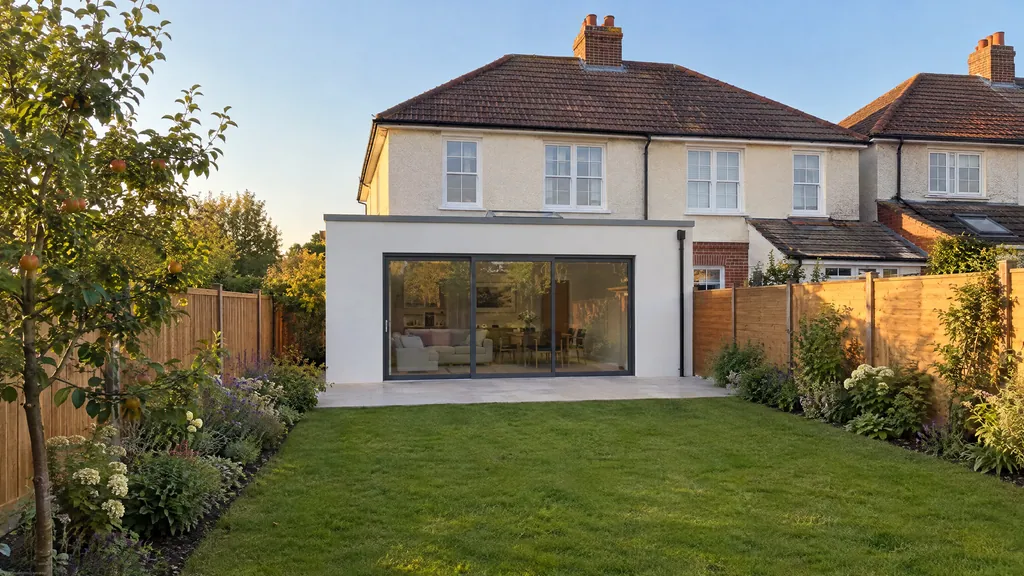
Planning tips the balance towards extending. Under the 2026 exempted development regulations (S.I. 338 to 344 of 2026), a rear extension of up to 45 m² is usually exempt, up from 40 m². That total counts every extension built since 1 October 1964. You must also keep at least 25 m² of rear garden. Side and front extensions are not exempt, so you need planning permission for an extension there. Allow 12 to 16 weeks from drawings to a decision.
Single-storey at the rear, with 25 m² of garden kept and the height rules met. A Section 5 declaration costs €80 if you want certainty.
Up to 12 m² upstairs on a semi or terrace, at least 2 m from the party boundary, within the 45 m² total.
Allow 12 to 16 weeks for drawings, the council decision and the appeal window before work starts.
The Space You Actually Gain
Be honest about what you need. A single-storey rear extension adds kitchen, living and dining space, not usually a bedroom. It can free up the old front room as a playroom, office or ground-floor bedroom, though. For a true fourth bedroom upstairs, consider a two-storey rear extension at €2,200 to €3,100 per m² in Dublin. A dormer attic conversion costs €35,000 to €60,000 in Dublin (Build Me estimates).
When Does Moving Make More Sense Than Extending?
Extending wins on cost for most 3-bed semis, but not for every family. Use the checklist below to see which side your situation falls on.
- Extend if: you like your area and schools, and your garden can keep 25 m² after the extension.
- Extend if: you need more living space rather than more bedrooms.
- Extend if: your mortgage is on a good fixed rate, or your income limits a bigger loan.
- Move if: you need two or more extra bedrooms, and the plot is too small for an exempt extension.
- Move if: your work, family or schools are pulling you to a different part of Dublin anyway.
- Move if: your house would cost more to extend than the street can support when you sell. Ask a local agent for a ceiling price first.
- Either way: get a written extension quote and a valuation of your home before you decide.
- About €100,000 to €150,000 less cash than moving up in our example
- No stamp duty, agent fees or removals
- Same schools, neighbours and commute
- 12 to 16 weeks of building work at home
- Adds living space, not usually an extra bedroom
- Garden gets smaller
- Extra bedroom and space all at once
- The price gap goes into a more valuable home
- A chance to change location
- About €29,400 in costs you never get back
- Limited choice of 4-beds for sale
- A bigger mortgage, tested at 3.5 times income
Send us your floor plan and photos of the back of your house. We will come back with a fixed-price extension quote you can compare with the cost of moving.
FAQ
Is it cheaper to extend or move in Dublin?
For most 3-bed semis, extending is cheaper. In our October 2026 example, moving up to a 4-bed needs about €269,400 in cash. A 30 m² extension with a new kitchen costs €116,250 to €169,540 (Build Me estimate).
How much does it cost to move house in Ireland?
Selling a €635,000 house and buying an €875,000 one costs about €29,400 in our example. That covers estate agent and solicitor fees, stamp duty, Land Registry fees, a survey and removals.
How much stamp duty will I pay on a bigger house?
Revenue charges 1% on the first €1 million, 2% from €1 million to €1.5 million and 6% above that. An €875,000 house carries €8,750 in stamp duty.
Does an extension add value to my house?
Usually, but it depends on your street. Ask a local estate agent what similar extended houses sold for. Then you will not spend more than the area supports.
Do I need planning permission to extend instead of moving?
A rear extension of up to 45 m² is usually exempt under the 2026 rules, if you keep 25 m² of garden. Side and front extensions need planning permission.
Can I live in my house while the extension is built?
Most families do. Expect noise, dust and a temporary kitchen over the 12 to 16 weeks on site. The hardest weeks are when the old rear wall is opened up.
Useful Tools and Resources
- Build Me extension cost calculator: prices any extension type and size in Dublin or the rest of Ireland.
- Revenue stamp duty rates: the official residential rates and how they are applied.
- CCPC guide to selling a house: estate agent fees, BER, chains and what to ask before you list.
- Central Bank mortgage measures: how much you can borrow as a second or subsequent buyer.
- CSO Residential Property Price Index: monthly price changes and median prices by area.
- Tailte Éireann Land Registry fees: the fee scale for registering a purchase and a mortgage.
How We Checked These Figures
We checked stamp duty and VAT against Revenue's website on 25 October 2026. Land Registry fees come from the Land Registration (Fees) Order 2012. Estate agent fee ranges come from the CCPC. House prices come from the Daft.ie Sales Reports for Q1 and Q3 2026 and the CSO RPPI for August 2026. Mortgage and loan rates come from the Central Bank's August 2026 retail interest rate statistics.
Daft.ie did not publish a Dublin-wide 4-bed semi figure. So we added the lower Q1 2026 area gap to the Q3 2026 Dublin 3-bed price. Solicitor fees use the midpoint of bonkers.ie's range. Extension prices, surveys, removals and other small costs are Build Me estimates for Dublin, including VAT. We re-check these figures every quarter.
Sources
- Daft.ie, Sales Price Report Q3 2026 (28 September 2026)
- TheJournal.ie, Slowdown in Dublin house prices amid a fall in demand from homebuyers (28 September 2026)
- Herbert Lansdowne Estate Agents, House Price Trends Dublin, Daft.ie Sales Report 2026 Q1 (2 April 2026)
- Central Statistics Office, Residential Property Price Index August 2026 (13 October 2026)
- Revenue, Stamp Duty rates (published 22 October 2025, accessed 25 October 2026)
- Revenue, Current VAT rates (published 1 January 2026)
- Competition and Consumer Protection Commission, Selling a house (accessed 25 October 2026)
- bonkers.ie, The extra costs to consider before buying your first home (accessed 25 October 2026)
- Irish Statute Book, Land Registration (Fees) Order 2012, S.I. No. 380 of 2012
- Tailte Éireann, Summary of Land Registry Fees Order (17 February 2025)
- Central Bank of Ireland, Retail Interest Rates, August 2026
- Central Bank of Ireland, What are the mortgage measures? (accessed 25 October 2026)
- Planning and Development (Exempted Development (Act of 2000)) Regulations 2026, S.I. 338 to 344 of 2026 (commenced 27 July 2026)