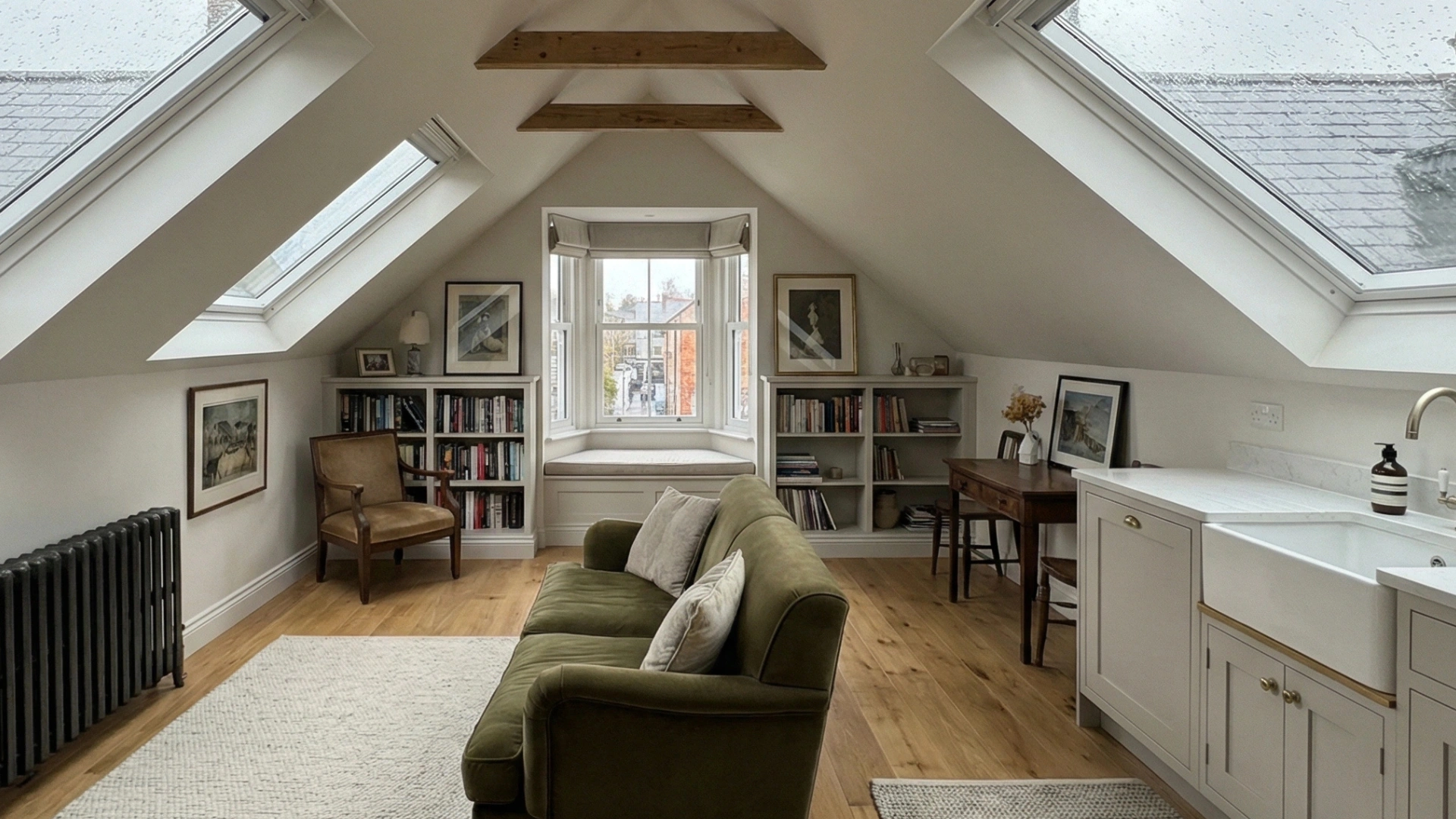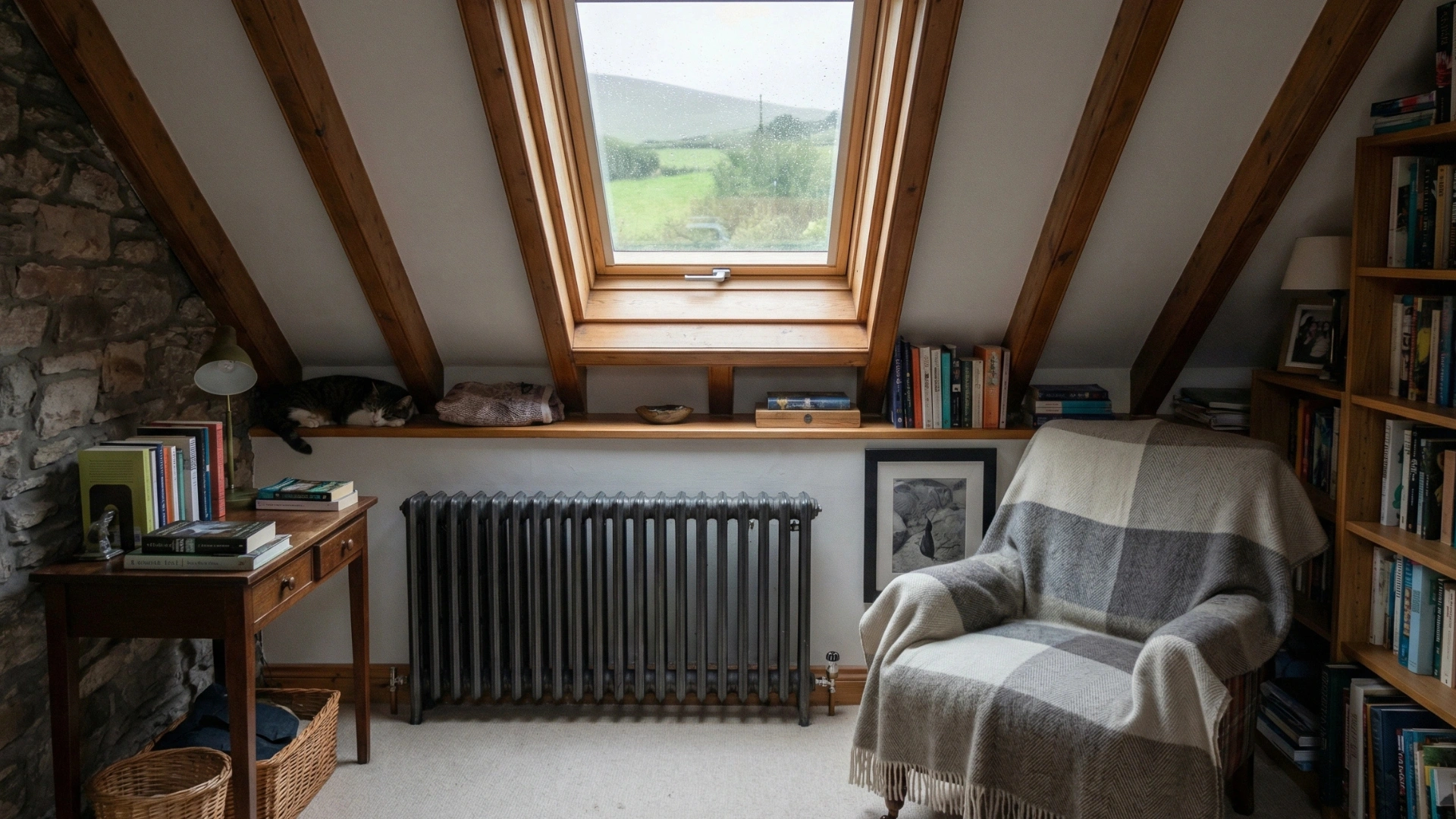
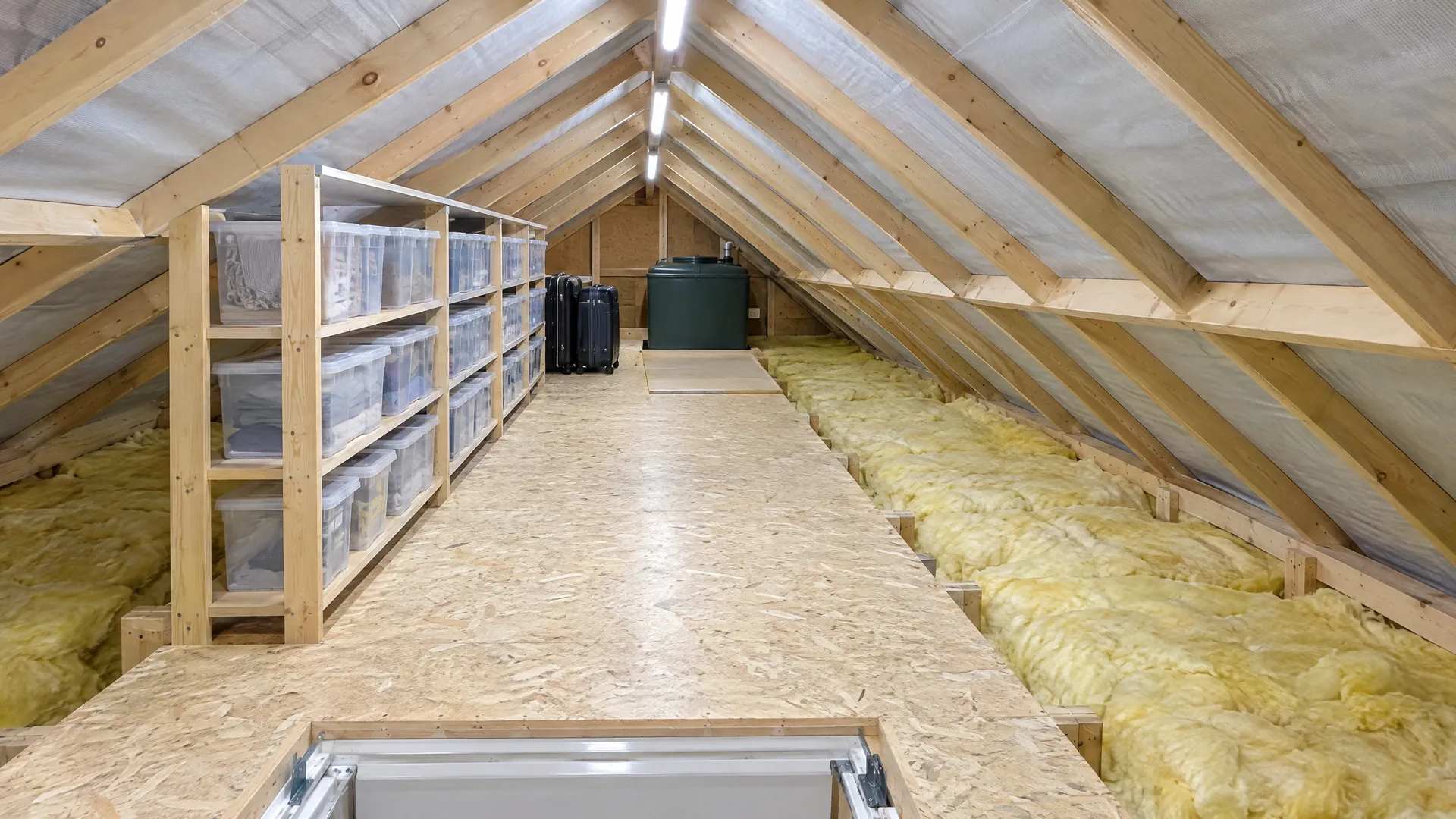

The best attic storage in an Irish home starts with raised boarding over the insulation, a folding loft ladder and a light. Then add lidded plastic boxes, low shelving under the eaves and a clear path to the water tank. Expect about €1,200 to €1,800 for raised boards and a ladder in Dublin (Build Me estimate). Never cut or overload the roof trusses.
Most Irish attics were boarded when insulation was about 100 mm deep. Today the recommended depth is 300 mm to 400 mm, according to An Post's 2025 insulation guide. That means a floor nailed straight onto the joists now squashes the insulation that keeps your house warm. Good attic storage solutions work around that, not against it.
What Counts as Good Attic Storage in an Irish Home?
Good attic storage is a dry, ventilated and lit area that you can reach safely. Its floor sits above the insulation and spreads loads evenly across the ceiling joists. It holds light, seasonal items in sealed boxes. It is not a habitable room, and it does not need planning permission or a building regulations sign-off.
In practice, that comes down to five parts. You need a safe way up, a floor, light, a system for boxes and a roof space that stays dry. Get those right and a typical 3-bed semi gains a useful storage area for suitcases, Christmas decorations, baby clothes and camping gear.
The table below compares the main attic storage solutions. Prices are Build Me estimates for Dublin or Irish retail prices checked in October 2026.
| Attic storage solution | Typical cost | Best for |
|---|---|---|
| Raised boarding on loft legs (about 30 m²) | €900 to €1,400 fitted | Any attic with 300 mm of insulation |
| Folding timber loft ladder | €400 to €700 fitted; from €154 to buy | Safe, regular access |
| LED batten light | €100 to €200 fitted | Finding things without a torch |
| Lidded plastic boxes (IKEA SAMLA 45 l) | €9 each | Clothes, toys, decorations |
| Low shelving under the eaves (IKEA IVAR 124 cm) | €67 per unit | Small items you need to see |
| Eaves cupboards in a converted attic | Part of a full attic conversion | Bedrooms and home offices |
Source: Build Me estimates (Dublin, 2026, incl. VAT); IKEA Ireland and TJ O'Mahony prices checked 25 October 2026.
How Do You Board an Attic for Storage Without Crushing the Insulation?
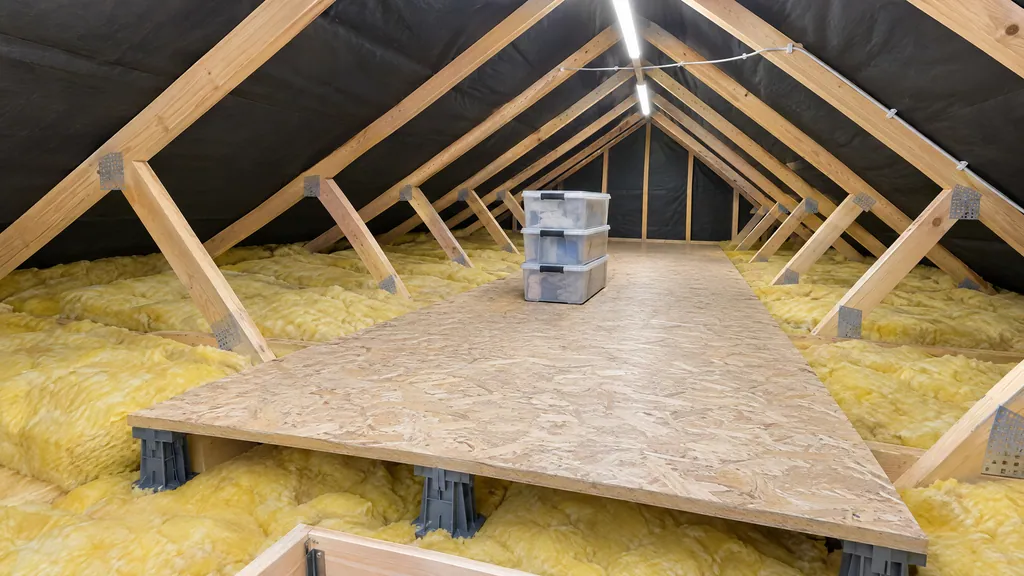
You raise the floor on loft legs, also called loft stilts. These are plastic or timber supports screwed to the top of each ceiling joist. The boards sit on the legs, leaving a clear gap above the insulation so it keeps its full depth.
The height matters. If your attic has about 300 mm of mineral wool, you need legs that lift the boards above that level. TJ O'Mahony, for example, lists a 300 mm loft leg for boarding over deeper insulation at €25.98 (October 2026). Boarding straight onto 100 mm joists would compress the wool and cut its insulating value. Use screws, not nails, so boards can be lifted later.
Board only the area you need. A strip from the hatch to the tank, plus a central storage zone, is enough for most families. Leave the eaves clear for airflow. Our attic flooring guide covers board types, joist sizes and fitting steps in detail.
Top Up the Insulation First With the SEAI Grant
If your attic insulation is thin, upgrade it before the boards go down. It is far cheaper than lifting a new floor later. SEAI offers an attic insulation grant of up to €2,000 for a detached house; check seai.ie for current amounts.
The rules are strict. The grant must be approved before work starts or materials are bought. The work must be done by an SEAI-registered contractor. Most individual grants are for homes built and occupied before 2011, and a BER follows the work.
Build Me offers SEAI grant work through our SEAI-registered partner contractor. An attic insulation upgrade can be part of your storage project, with the grant applied for before work starts. Your raised boarding then goes in over the new insulation. The other home renovation grants in Ireland can sometimes be combined with it.
One more SEAI rule helps with storage. SEAI's August 2021 technical bulletin covers attics with a cold water tank. There, the contractor must build "a permanent boarded walkway" from the hatch to the tank. That walkway is a good spine for your storage layout.
How Much Weight Can Attic Trusses Hold?
Less than most people think. Most Irish houses built from the 1990s onwards have trussed rafters. These are factory-made timber triangles joined with metal nail plates. Each member works with the others, so the whole roof relies on every piece staying intact.
The bottom chord of each truss is also your ceiling joist. It was designed to carry the ceiling, the insulation and light storage, not a gym or a filing room. Older houses often have a cut roof, built on site from rafters, purlins and struts. Their ceiling joists are usually small too, often around 100 mm deep.
The safe rules are simple:
- Never cut, notch or remove any truss member, even a diagonal web that is in the way.
- Store light, bulky things. Keep heavy items such as books, paperwork and paint over the wall below.
- Spread the load across the boarded area rather than stacking in one spot.
- Do not hang heavy loads from rafters or webs.
If you want to store anything heavy, or the joists sag or feel springy, ask a structural engineer to check the roof first. The attic flooring guide gives typical joist sizes and warning signs.
Cutting one web to make room for boxes can weaken the whole roof. Any change to trussed rafters needs an engineer's design. That is a structural alteration, not a storage job.
Which Attic Ladder or Stairs Should You Fit?
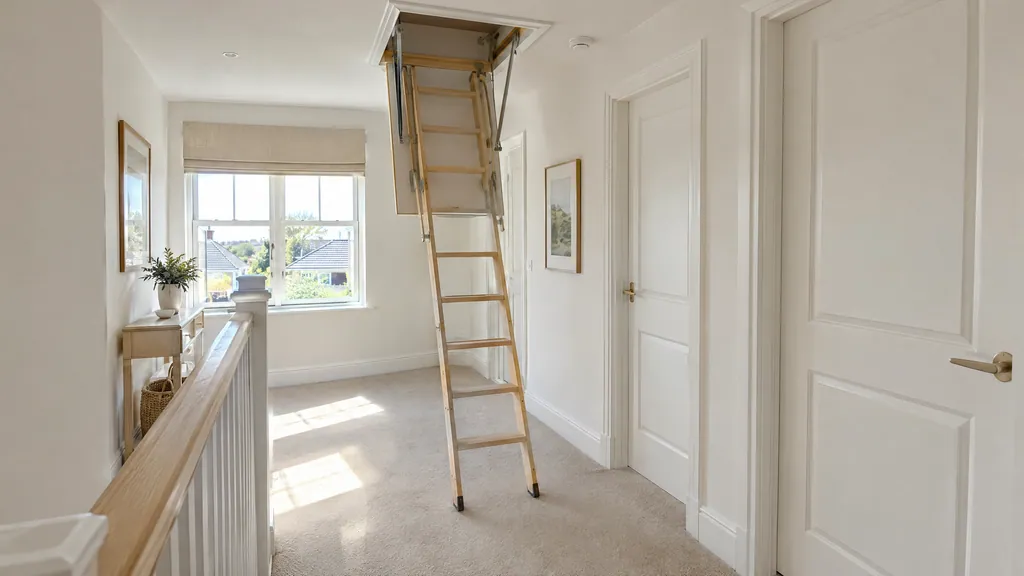
A fold-down loft ladder is the single best upgrade for attic storage. Climbing a stepladder through a small hatch with a box in your arms is how most attic falls happen. A fitted ladder makes the attic usable every week, not just at Christmas.
There are two common types. A folding timber ladder comes as a kit with its own insulated hatch. TJ O'Mahony lists a Minka 1200 x 600 mm timber loft ladder at €154.43 (October 2026). It has a 2.8 m drop and a 150 kg rating. B&Q Ireland lists a Mac Allister 4-section timber ladder kit at €265. Sliding aluminium ladders suit smaller hatches but feel less solid underfoot.
Most kits need a ceiling opening of about 1200 x 600 mm. Many older hatches are smaller, so the opening often has to be widened and trimmed. On a trussed roof, that must happen between trusses, without cutting any. Fitted, a timber ladder costs about €400 to €700 in Dublin (Build Me estimate). Choose an insulated, draught-stripped hatch, as SEAI requires for grant-aided attics.
Do You Need Lighting and a Socket in the Attic?
A light, yes. A socket, it helps. Searching for a box by phone torch is slow and risky when you are balancing on boards. A fixed LED batten with a switch near the hatch makes the attic as easy to use as a hot press.
A socket is useful if you want to run a dehumidifier, a vacuum or a work lamp. It also saves trailing an extension lead up the ladder and through the hatch. Keep any socket on the boarded area, clear of the insulation and away from the water tank.
Electrical work in an Irish home must be done by a Registered Electrical Contractor. Safe Electric says you should "ALWAYS use a Registered Electrical Contractor" and that they must give you a certificate of completion. Budget about €100 to €200 for a fitted LED light (Build Me estimate). A new socket depends on how far the cable has to run, so ask your electrician to price it with the light. Doing both on the same visit saves a call-out.
Cables should be clipped to timber and kept above the insulation, not buried under it, so they do not overheat.
What Are the Best Attic Storage Ideas With Trusses and Eaves?
The shape of your roof decides the layout. Trusses break the space into narrow bays about 600 mm apart, and the eaves drop to almost nothing at the edges. Work with that shape rather than fighting it.
Truss Bays and Freestanding Shelves
Use each bay between trusses as a slot for boxes of the same width. Line the bays up along the central walkway so every box is reachable without climbing over others.
For attic truss storage shelves, choose freestanding units that sit on the boards, rather than shelves screwed to the trusses. A low unit spreads its weight through the floor and puts no extra stress on the roof timbers. IKEA Ireland sells the IVAR pine shelving unit, 89 x 30 x 124 cm, for €67 (October 2026). The smaller HYLLIS steel unit, 60 x 27 x 74 cm, costs €15. Both fit under a typical slope.
Keep the top shelf for light things. Put the heaviest boxes on the floor, close to the wall below. Never hang a rail or shelf from a truss web or a single rafter.
Eaves Storage in an Unfinished Attic
The low triangle near the eaves is tempting but tricky. That is where air enters the roof through the soffit vents, and where the insulation must run to the wall. Blocking it with boxes traps moisture.
Keep at least the outer part of the eaves completely clear. Use the zone just inside it for long, flat, light items. Think of a folded travel cot, an artificial Christmas tree box or rolls of spare carpet. Low, wheeled under-bed boxes slide in and out easily.
If you need to reach the eaves often, a full eaves cupboard is better. That is a finished, insulated storage space, usually built as part of an attic conversion. We cover it in the converted attic section below.
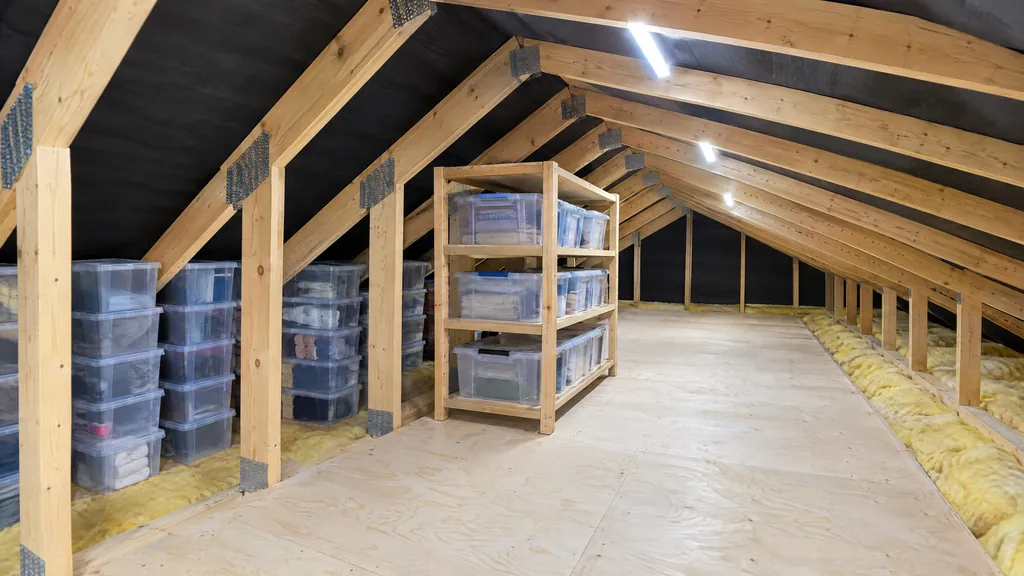
Air enters the roof at the eaves. Boxes pushed into that gap block it and trap moisture, so keep the outer eaves empty.
How Should You Box and Label Attic Storage?
Use lidded plastic boxes, not cardboard. Cardboard soaks up moisture, sags when stacked and attracts insects and mice. Clear plastic lets you see what is inside without opening every lid.
IKEA attic storage is a popular choice because the boxes stack and come in many sizes. IKEA Ireland lists the SAMLA 45 litre box with lid at €9 and the 65 litre version at €12 (October 2026). Smaller 22 litre boxes with a lid cost €8. Buying one size for most of the attic makes stacking far neater.
A simple system works best:
- Zone by season: Christmas near the hatch, summer gear further back, long-term keepsakes at the far end.
- Label two sides: write the contents on the end and the top, so labels show whichever way a box is stacked.
- Keep a list: a note on your phone with box numbers saves trips up the ladder.
- Limit the weight: fill large boxes with light, bulky things and small boxes with heavy ones.
- Bag the textiles: seal clothes and bedding in bags inside the boxes as a second layer against damp.
How Do You Stop Damp and Condensation in Attic Storage?
Keep the roof space ventilated. A cold attic stays dry only if outside air can flow in at the eaves and out again. Warm, moist air from the house rises into it. If that air cannot escape, it condenses on the cold felt and timbers.
SEAI's November 2024 technical bulletin says ceiling-level insulation must not block air entering the roof. It calls for a continuous gap of at least 10 mm at the soffit or fascia, or ventilation tiles where that is not possible. The same bulletin warns that long-term condensation "can lead to structural roof timbers rotting".
For storage, that means four things. Keep boxes and boards back from the eaves. Make sure bathroom and kitchen extract fans vent outside, not into the attic; SEAI inspectors flag ducts ending in the roof space. Keep the hatch draught-stripped so less warm air leaks up. Check the attic after a cold snap for drips, black mould spots or damp patches on the felt.
If you see damp, stop adding storage and find the cause first. A missing slate or a blocked vent is cheaper to fix now than rotten timbers later.
- Ventilation gap: at least 10 mm at the soffit or fascia (SEAI, 2024).
- Extract fans: vented outside, never into the attic.
- Hatch: draught-stripped to cut warm, moist air.
- After a cold snap: check for drips, mould spots or damp felt.
How Much Clearance Should You Leave Around the Water Tank?
Enough to reach and work on it. The cold water tank needs regular access for the ball valve, the lid and the pipes. A plumber also needs room to kneel beside it if a valve fails at night.
As a rule of thumb, keep a clear boarded path from the hatch to the tank. Leave a clear working area beside the ball valve. Never stack boxes against the tank or on its lid. A full tank is also heavy, and it was placed on specific supports. Do not add storage loads next to it.
The tank and its pipes should be insulated too. SEAI's 2021 bulletin says water storage tanks in unheated roof spaces "should be insulated", with no gaps in the insulation around them. If your insulation is being upgraded, the contractor should do this as part of the job. Keep the tank lid on to stop dust and insects getting in.
What Should You Not Store in an Attic?
An Irish attic swings from close to freezing in winter to very warm on a sunny July afternoon. Humidity rises and falls with it. Anything sensitive to heat, cold or damp will suffer up there.
Paint, aerosols, solvents and gas canisters. Candles, vinyl records and photos. Important papers, passports and certificates.
Clothes, bedding and soft toys in sealed bags inside lidded boxes. Wooden furniture can warp or crack.
Christmas decorations, suitcases, camping gear, plastic toys, empty boxes for electronics and seasonal sports kit.
Electronics such as old laptops and games consoles are best kept indoors. Food, pet food and bird seed attract mice. Heavy items such as books and tools belong in a garage or shed, not on ceiling joists.
What Storage Works in a Converted Attic Bedroom?
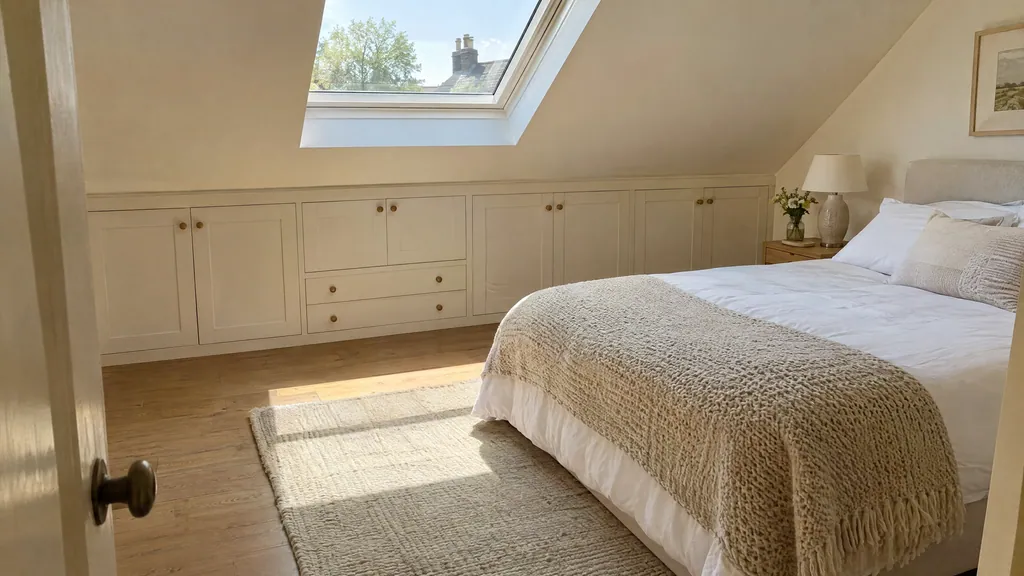
In a converted attic, the eaves become your best storage. The space behind the low knee walls is usually wasted, yet it runs the full length of the room. Built-in eaves cupboards turn it into deep, hidden storage without taking floor space.
The most useful attic bedroom storage ideas are:
- Eaves cupboards: hinged or sliding doors in the knee wall, opening into an insulated, lined void.
- Pull-out drawers: deep drawers on runners built into the knee wall, ideal for clothes.
- Built-in wardrobes: placed under the highest part of the ceiling, often at the gable end or inside a dormer.
- Under-stair storage: drawers or a cupboard under the new staircase.
- Window seats: a lift-up seat in a dormer with storage below.
Plan this storage at design stage, not after. The eaves void must stay inside or outside the insulated envelope by design, and ventilation must still work. If you are planning a full conversion, Build Me's attic conversion service includes built-in eaves storage as part of the layout.
Storage-Only Attic Conversion or Full Attic Conversion?
A storage-only conversion turns the attic into a finished, lined storage room, but not a habitable room. It may have flooring, plasterboard, a rooflight, lighting and a loft ladder. A full conversion builds a room people can live or sleep in, meeting every relevant Building Regulation.
The difference is legal, not cosmetic. A habitable attic needs a structural floor, fire protection and a protected escape route. It also needs a compliant fixed stairs, insulation in the roof slope and ventilation. A storage room needs safe construction, but not those room standards. The full rules are in our guide to attic conversion regulations in Ireland.
| Storage-only conversion | Full attic conversion | |
|---|---|---|
| Legal use | Storage, not a bedroom | Habitable room |
| Access | Loft ladder | Fixed stairs to Part K |
| Fire safety and escape | Not designed for sleeping | Required (Part B) |
| Floor structure | Storage loads | Engineer-designed for room loads |
| Counts as a bedroom on sale | No | Yes, with compliance paperwork |
| Cost (Dublin) | Depends on finish | From €22,000 (rooflight) |
Source: Building Regulations Parts A, B, F, K and L; Build Me attic conversion prices, 2026, incl. VAT.
Do You Need Planning Permission?
Usually not for storage. Rear rooflights that do not materially change the look of the house are generally exempt. Under the 2026 exempted development regulations (S.I. 338 to 344 of 2026), up to two front rooflights, each no more than 100 cm x 90 cm, are also exempt.
Side or rear dormers are exempt if all dormers together hold no more than 30 m³ inside. They must also sit below the ridge and be set back at least 20 cm from the eaves. Front dormers, hip-to-gable and mansard roofs still need planning permission. Protected structures and Architectural Conservation Areas have tighter rules. A Section 5 declaration from the council (€80) confirms whether your plan is exempt.
Planning is only half the picture. Building Regulations apply even when planning permission does not.
Selling a House With a "Storage" Attic
This is where the shortcut can cost you. Many Irish attics were finished as "storage" and then used as bedrooms. When you sell, the buyer's solicitor will ask for evidence that any converted attic complies with the Building Regulations.
A storage attic cannot honestly be sold as a bedroom. In a 2024 ruling, the Advertising Standards Authority of Ireland upheld a complaint about a Dublin house advertised with four bedrooms. One was an attic room. The ASAI found proof that it "could rightfully be considered a bedroom had not been provided".
So if you plan to use the attic as a bedroom, build it as one from the start. A compliant full conversion adds a real bedroom to your sale. A storage room adds storage, and should be described that way.
How Much Does Attic Storage Cost in Ireland?
Basic attic storage is one of the cheapest space upgrades in a house. Most of the cost is the floor and the ladder. Boxes and shelving add a few hundred euro at most.
| Item | Typical cost (Dublin, 2026) | Basis |
|---|---|---|
| Standard boarding, about 30 m² | €600 to €900 | Build Me estimate, supply and fit |
| Raised boarding on loft legs, about 30 m² | €900 to €1,400 | Build Me estimate, supply and fit |
| Loft ladder, fitted | €400 to €700 | Build Me estimate |
| Raised boarding plus loft ladder | €1,200 to €1,800 | Build Me estimate |
| LED light, fitted | €100 to €200 | Build Me estimate |
| Timber loft ladder kit (DIY) | €154 to €265 | TJ O'Mahony, B&Q Ireland, Oct 2026 |
| 10 SAMLA 45 l boxes with lids | €90 | IKEA Ireland, Oct 2026 |
| Full attic conversion with rooflights | €22,000 to €35,000 | Build Me price range |
Prices include VAT. Outside Dublin, boarding and ladder fitting typically run 10 to 15% lower (Build Me estimate).
A storage-only conversion with plasterboard and a rooflight sits between these two levels. It needs many of the same trades as a full conversion, so the saving is often smaller than people expect. Price both before deciding. For a full room, the attic conversion cost guide breaks down each type, from rooflight to mansard.
How Do You Set Up Attic Storage, Step by Step?
Do the jobs in this order, so nothing has to be lifted or redone later.
- Day 1Inspect the attic first.Check the roof type, the joist condition, the insulation depth, the tank position and any signs of damp or leaks.
- Weeks 1 to 4Upgrade the insulation if it is thin.Apply for the SEAI attic insulation grant before any work starts, and use an SEAI-registered contractor.
- Day 2Fit the loft ladder and hatch.Widen the opening between joists or trusses if needed, without cutting any truss, and fit an insulated, draught-stripped hatch.
- Day 2Raise and lay the boards.Screw loft legs to the joists above the insulation, then screw boards on top, keeping the eaves clear.
- Day 3Add a light and a socket.Have a Registered Electrical Contractor fit them and give you a completion certificate.
- WeekendBox, label and zone your storage.Pack light items in lidded plastic boxes, label two sides and keep a clear path to the water tank.
Tell us what you want from your attic. We will tell you honestly whether storage or a full conversion makes more sense for your house and budget.
FAQ
Can I store things in an attic with trussed rafters?
Yes, light and evenly spread storage is fine on raised boards over the ceiling joists. Never cut or remove any truss member, and ask a structural engineer before storing anything heavy.
Do I need planning permission to floor my attic for storage?
No. Boarding an attic for storage is internal work and does not need planning permission. Adding front dormers or changing the roof shape is different, and may need it.
Can I put boards straight onto the joists over my insulation?
Only if the insulation stays below the top of the joists. With today's 300 mm or more, use raised loft legs so the boards sit above the insulation without squashing it.
Can I use a storage attic as a bedroom?
Not legally. A bedroom must meet Building Regulations for structure, fire safety, escape and stairs. A storage room does not, and it cannot be sold or advertised as a bedroom.
What is the best way to stop damp in attic storage?
Keep the eaves vents clear, make sure extract fans vent outside, draught-strip the hatch and use sealed plastic boxes. Check the attic after cold spells for condensation.
How much does it cost to make an attic usable for storage?
In Dublin, raised boarding and a fitted loft ladder cost about €1,200 to €1,800 (Build Me estimate). A light adds about €100 to €200.
Next Steps
- This week: go up with a torch and note the roof type, insulation depth, tank position and any damp.
- Within 2 weeks: if the insulation is under 300 mm, check your SEAI grant eligibility before booking any work.
- Within a month: get quotes for raised boarding, a loft ladder and a light, ideally on the same visit.
- After fitting: buy one size of lidded box, label two sides and zone the space by season.
- If you need a room: get drawings and a structural assessment for a full conversion instead of a storage room.
Useful Tools and Resources
- Build Me attic conversion calculator: estimates a full conversion by type, size and location.
- SEAI attic ventilation bulletin: shows how eaves ventilation should work with ceiling insulation.
- Safe Electric: find a Registered Electrical Contractor by county for an attic light or socket.
- IKEA Ireland SAMLA boxes: stackable clear boxes in sizes from 5 to 130 litres.
Sources
- An Post, The best home insulation grants in Ireland you need to know about, 14 July 2025.
- SEAI, Technical Bulletin: Attic Insulation, August 2021.
- SEAI, Technical Bulletin: Roof Insulation, Ventilation, November 2024.
- TJ O'Mahony, Loft Leg 300mm Raised Loft Boarding Support, price checked 25 October 2026.
- TJ O'Mahony, Minka 1200 x 600mm Standard Loft Ladder 2.8m Drop, price checked 25 October 2026.
- B&Q Ireland, Mac Allister 4 section 12 tread loft ladder kit, price checked 25 October 2026.
- IKEA Ireland, SAMLA box with lid 65 l, price checked 25 October 2026.
- IKEA Ireland, IVAR shelving unit 89 x 30 x 124 cm, price checked 25 October 2026.
- IKEA Ireland, HYLLIS shelving unit 60 x 27 x 74 cm, price checked 25 October 2026.
- Advertising Standards Authority of Ireland, Complaint: Property (MoveHome), published 8 January 2024.
- Safe Electric, homeowner guidance on Registered Electrical Contractors, checked 25 October 2026.
- Planning and Development (Exempted Development) Regulations 2026, S.I. 338 to 344 of 2026, commenced 27 July 2026.