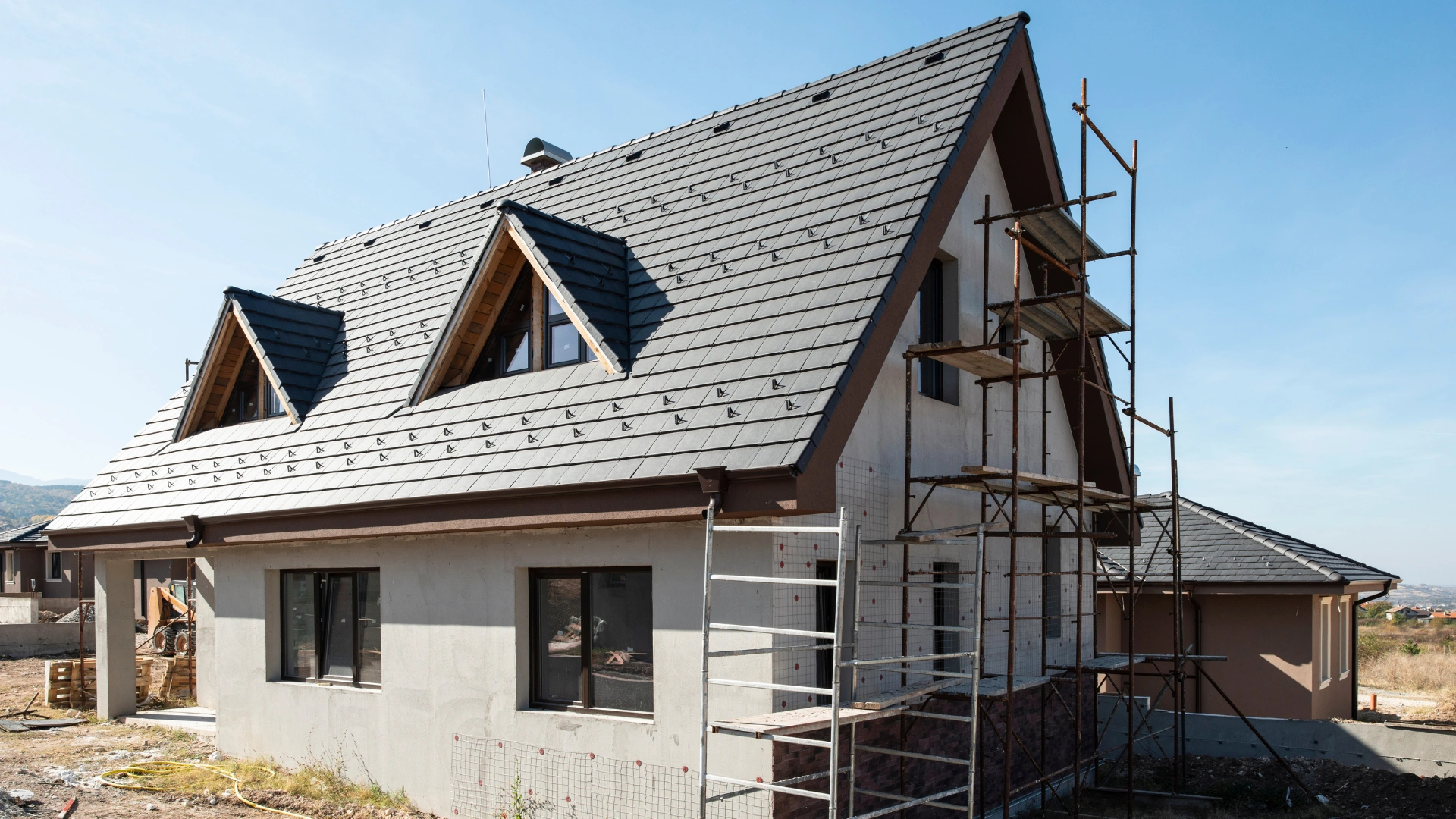
Building a house in Ireland in 2026 costs between €1,500 and €3,500+ per square metre depending on house type, specification, location, and site conditions. A standard 150m² three-bed two-storey house in Leinster costs approximately €330,000 to €450,000 to build, excluding land. Use the calculator above to get an instant estimate based on your specific inputs.
build cost (inc. VAT 13.5%)
professional fees (10–15%)
architect, engineer, QS
contingency (15%)
set aside before starting
total project budget
build + fees + contingency
Typical build cost breakdown
Additional costs not included above
These figures are estimates only. A quantity surveyor or architect’s cost plan based on your specific site, design, and specification is the only accurate figure. SCSI (Society of Chartered Surveyors Ireland) publishes annual benchmark rates at scsi.ie.
What the Calculator Includes and What It Does Not
The figures above cover the build cost including VAT at 13.5%, an estimate for professional fees (architect, structural engineer, and quantity surveyor at 10 to 15% of build cost), and a 15% contingency. These are the three costs that form the core project budget for any self-build in Ireland.
The calculator does not include land purchase, development levies (€2,000 to €20,000+ depending on local authority), site development costs (water, electricity, and sewage connections: €15,000 to €40,000), house renovations, planning permission (€1,500 to €4,000 for drawings and application), or a septic tank if the site is not on mains drainage (€8,000 to €20,000). These items are highly variable and site-specific, but together they typically add €30,000 to €80,000+ to the total cost of a self-build project in Ireland. Every self-build budget must account for them from the outset.
What Drives the Cost of Building a House in Ireland
House type
the biggest single variable in the build cost per m². A two-storey house is almost always the most cost-efficient option per square metre because the roof and foundation costs are shared across two floors. A bungalow of the same floor area costs 10 to 15% more per m² because it has a larger roof footprint and a larger foundation relative to the habitable area it creates. A passive house or high-spec build costs 40 to 60% more per m² than a standard spec build but delivers significantly lower energy running costs over the life of the building.
Location
affects labour costs, material delivery, and subcontractor availability. Dublin and the greater Dublin area consistently run 10 to 15% above the national average. Rural Connacht and Ulster typically run 5 to 10% below.
Specification
is the most controllable variable. The difference between a standard spec and high-spec finish on a 150m² house is typically €80,000 to €150,000. Deciding on specification before briefing an architect, rather than after, is one of the most effective ways to control a self-build budget.
VAT
at 13.5% applies to all residential construction in Ireland. It is not optional and it is not negotiable. Any cost estimate or per m² rate that does not explicitly include VAT is understating the true cost by 13.5%. The figures in this calculator include VAT throughout.
Professional Fees: What to Budget
Professional fees on an Irish self-build typically run 10 to 15% of the total build cost. For a €350,000 build, that is €35,000 to €52,500. The main professionals involved are an architect or architectural technologist who produces the design, planning drawings, and technical specifications, a structural engineer who designs the foundations, structural elements, and issues compliance certificates, and a quantity surveyor if the project is large enough to warrant cost management throughout the build rather than just at tender stage.
These fees are not optional for a regulated self-build. Under BCAR (Building Control Amendment Regulations), an Assigned Certifier and a registered builder must be appointed before a Commencement Notice is submitted to the local Building Control Authority. The certifier monitors compliance throughout the build and issues the Certificate of Compliance at the end, which is required when you come to sell or mortgage the property.
How Accurate Is This Calculator?
The calculator is based on 2026 Irish market benchmarks aligned with SCSI (Society of Chartered Surveyors Ireland) published data and current trade rates in Ireland. It is accurate enough for early-stage budget planning and for understanding the relative cost of different house types and specifications.
It is not a substitute for a quantity surveyor’s cost plan or a contractor’s tender figure based on full drawings. For a project of this scale, a proper cost plan from a qualified quantity surveyor is money well spent before any planning application is submitted. The SCSI publishes annual rebuild cost data at scsi.ie which provides an independent benchmark.