A bathroom renovation designed for an older person typically costs between €5,000 and €12,000 in Ireland, depending on the scope of work and the level of adaptation required. Most of that cost is recoverable through two government grant schemes, the Mobility Aids Grant (up to €8,000) and the Housing Adaptation Grant for People with a Disability (up to €30,000), meaning many families pay significantly less out of pocket than they expect. This guide covers what to change, what the grants cover, and how to plan a project that keeps an older person safe, comfortable, and independent at home for as long as possible.
Why Bathroom Safety Matters for Older People in Ireland
The bathroom is the most dangerous room in the house for an older person, and the data backs that up.
Research published in BMJ Open in February 2026 by the Irish Longitudinal Study on Ageing (TILDA) at Trinity College Dublin found that one in eight people aged 70 and over in Ireland require medical attention for a fall in any given year. That works out to almost 62,000 older adults needing medical care annually, with over 32,000 attending emergency departments. Falls are already the most common reason older people are admitted to hospital in Ireland, and the problem will get worse as the population ages. Ireland has the fastest ageing population in the EU (TILDA, BMJ Open, 2026).
The bathroom is a major contributor to that figure. Wet, slippery floors, high bath sides, low toilet seats, and the absence of anything solid to hold onto create exactly the conditions where falls happen. A well-planned bathroom renovation changes all of that.
The good news is that most of the adaptations that make a real difference are not expensive in themselves. Grab rails, a level access shower, a raised toilet seat, non-slip flooring: these are practical, durable changes that can be completed in a week. The challenge, as we see it on jobs across Dublin, is planning them properly so the room works well rather than just looking modified.
What Changes Make the Biggest Difference?
Not every bathroom renovation for an older person needs to be a full redesign. The changes that deliver the most safety benefit per euro spent are relatively consistent across the jobs we do.
1. Remove the bath, install a level access shower
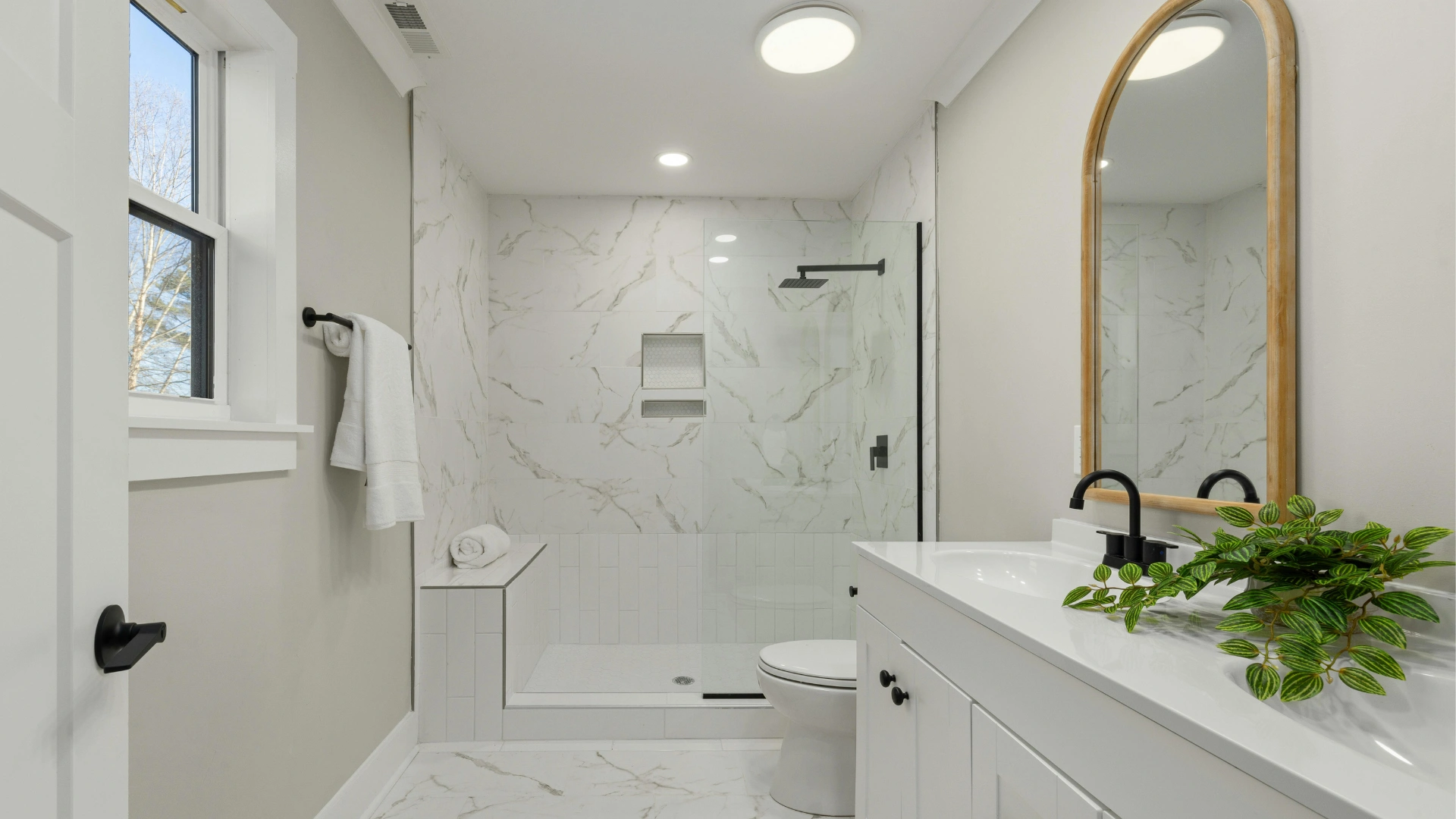
This is the single most impactful change in most cases. Getting in and out of a bath requires balance, flexibility, and strength that diminishes with age. A level access shower, flush with the floor with no step or lip, removes that risk entirely. For the vast majority of older people, a walk-in shower is both safer and easier to use day to day.
2. Fit grab rails in the right positions.
The key word is right. A grab rail in the wrong position gives false confidence and can make a fall worse. Rails need to be positioned based on how the person actually moves, getting in and out of the shower, sitting and standing from the toilet, moving around the room. For any project involving grant funding, an Occupational Therapist (OT) assessment will determine the correct positioning. For private work without a grant, it is still worth getting an OT recommendation before the rails go in.
3. Replace flooring with a slip-resistant surface.
Ceramic and porcelain tiles can become extremely slippery when wet, particularly for someone with a shuffling gait or reduced balance. Slip-resistant porcelain tiles with a higher R-rating (R10 or above for wet areas) are widely available and look identical to standard tiles. This is a straightforward upgrade that is done during any retile anyway.
4. Raise the toilet height.
A comfort-height toilet, sitting roughly 45cm from floor to seat rather than the standard 38 to 40cm, makes sitting and standing significantly easier for people with arthritis, hip replacements, or reduced strength in the legs. It is a simple swap during a bathroom renovation and adds nothing complicated to the project.
5. Widen the door if needed.
This is the change families most often overlook until it becomes urgent. A standard bathroom door is around 700mm wide. A wheelchair or walking frame typically needs at least 800mm of clear opening. If mobility needs are likely to increase, it is worth widening the doorway during the renovation rather than doing it as a separate project later. Doing it twice costs twice.
6. Install adequate lighting.
Poor lighting is a falls risk that rarely gets mentioned. A bathroom used by an older person should have bright, even illumination with no dark corners, and a light switch positioned so it can be reached without stepping into the room first. A motion-activated night light between the bedroom and bathroom is a low-cost addition that makes a real difference.
The Two Main Grants Available in Ireland
There are two government grant schemes that cover bathroom adaptations for older people and people with disabilities in Ireland, both administered through local authorities. In 2025, the Irish Government issued approximately €117 million in adaptation grants across the local authority network (Ageing in Place, 2025). Understanding which scheme applies to your situation is the first step.
The Mobility Aids Grant
The Mobility Aids Grant is specifically designed to fast-track funding for a basic suite of adaptations that address mobility problems in the home. It covers level access showers, grab rails, access ramps, stairlifts, and minor adaptation works, which covers most standard bathroom safety upgrades. Citizens Information has a clear, up-to-date breakdown of eligibility and how to apply at citizensinformation.ie.
| Grant details | Mobility Aids Grant |
|---|---|
| Maximum grant | €8,000 |
| Income threshold | Household income up to €30,000 gross per year |
| Who qualifies | Households where a member has a mobility difficulty |
| OT report required | For stairlifts; recommended for bathroom work |
| Administered by | Your local authority |
The application form is available from your local authority. The form includes a section to be completed by a GP. You cannot start the work before grant approval, so apply early.
The Housing Adaptation Grant for People with a Disability
The Housing Adaptation Grant covers more significant works, including adding an accessible shower, a ground-floor bathroom, or a full bathroom suitable for wheelchair use. It has a higher income threshold and a much higher maximum grant. Full details on the current scheme, including the updated December 2024 regulations, are available at citizensinformation.ie.
| Grant details | Housing Adaptation Grant |
|---|---|
| Maximum grant | €30,000 |
| Income threshold | Household income up to €75,000 gross per year |
| Grant percentage | Up to 95% of approved costs for lower incomes |
| Who qualifies | People with a physical, sensory, mental health or intellectual disability |
| OT report required | Yes, for most bathroom and extension works |
| Administered by | Your local authority |
The grant percentage scales down as household income increases, from 95% for incomes up to €30,000, reducing to 30% for incomes between €50,001 and €60,000. The grant does not cover VAT, but VAT on qualifying disability adaptations may be reclaimable directly from Revenue.
For both schemes, the grant is paid after the work is completed, not before. Work must start within six months of approval, and no work should begin before that approval comes through.
What Does an Accessible Bathroom Renovation Actually Cost in Ireland?
Even with grants, families want to know the real numbers before they start. Bathroom adaptations in Ireland typically range from €5,000 to €12,000 depending on the scope, with Dublin prices running 15 to 20% higher than the national average due to labour costs and demand (Renovation Dublin, 2025).
Here is a realistic cost breakdown for a standard accessible bathroom conversion in Dublin:
| Work | Typical Cost (Dublin) |
|---|---|
| Level access shower (supply and install) | €2,500 to €4,500 |
| Grab rails (4 to 6 positions, correctly specified) | €400 to €900 |
| Slip-resistant floor tiles (supply and fit) | €600 to €1,200 |
| Comfort-height toilet | €350 to €700 |
| Waterproofing and tanking | €400 to €700 |
| Door widening (where required) | €400 to €900 |
| Lighting upgrade | €200 to €500 |
| Full labour (strip-out, plumber, tiler, electrician) | €2,000 to €3,500 |
A full conversion in a small to mid-sized bathroom, removing the bath and fitting a level access shower with grab rails, new flooring, and a comfort-height toilet, typically comes in at €6,000 to €9,000 in Dublin. With the Mobility Aids Grant covering up to €8,000 for qualifying households, the out-of-pocket cost is often significantly lower.
For larger works, including moving plumbing, adding a downstairs bathroom, or full wet room conversions, the Housing Adaptation Grant covers up to €30,000, which covers the majority of even substantial projects. If your renovation is part of a wider energy upgrade, it is worth checking whether any SEAI grants apply alongside the adaptation grants.
Trade tip: If you are going to retile the floor anyway, fitting underfloor heating at the same time adds €400 to €600 to a small bathroom and costs very little extra in labour. For an older person who feels the cold, a warm bathroom floor first thing in the morning is a meaningful quality-of-life improvement, and far cheaper to add during the build than afterwards.
Should You Get an Occupational Therapist Involved?
Yes, and not just because the grant schemes require it for certain works.
An OT assessment identifies what the person actually needs based on how they move, what their specific conditions are, and what the realistic trajectory of their mobility looks like. A family member or a contractor can make reasonable guesses, but an OT maps the actual requirements. That prevents expensive mistakes, like grab rails in the wrong position, a shower that is difficult to get into for someone with a specific mobility pattern, or a layout that works fine now but will not work in two years.
For Housing Adaptation Grant applications, an OT report is required for most bathroom works. If the grant is approved, your local authority will reimburse up to €300 of the OT assessment cost as part of the grant. You can find a registered OT through the Association of Occupational Therapists Ireland.
If you are not applying for a grant, an OT assessment still costs €100 to €250 for a home visit and is worth every euro. Think of it as the brief for the renovation rather than an optional extra.
How to Plan the Project: Step by Step
Step 1: Get an OT assessment. Before you call a contractor, get the OT assessment done. It defines the scope of work you actually need.
Step 2: Apply for the relevant grant. Download the application form from your local authority. Submit early. The approval process can take several weeks, and no work can start before approval is confirmed.
Step 3: Get three written quotes. Make sure each contractor has seen the bathroom in person and is quoting for the exact same scope of work. Include the OT specification in what you send to each contractor.
Step 4: Check your contractor is properly registered. All plumbing work must be carried out by an RGI-registered plumber. All electrical work by an RECI-registered electrician. Both are legal requirements in Ireland, not preferences.
Step 5: Plan the timeline around the person. A bathroom renovation typically takes five to eight working days. If the person being accommodated needs the bathroom daily, arrange alternative facilities in advance. Some families plan the work when a parent is on a planned visit to relatives to minimise disruption.
Step 6: Do not start until grant approval is in writing. The grant is not awarded retrospectively. If work starts before approval, you lose the grant entitlement.
Planning Permission: Do You Need It?
In most cases, no. Standard accessible bathroom adaptations, including level access showers, grab rails, and comfort-height toilets, are interior works that do not require planning permission.
You may need planning permission if the works involve structural changes, adding a ground-floor extension to accommodate a new bathroom, or any modification to the external appearance of the property. For period properties or protected structures, additional restrictions may apply. Citizens Information has a clear guide to exempted development at citizensinformation.ie. When in doubt, contact your local authority planning office before starting any work.
One Last Thing Worth Saying
The conversation about adapting a bathroom for an older parent or family member is not always easy. There can be reluctance to acknowledge that changes are needed, or a feeling that it signals a loss of independence. In our experience, the opposite is usually true. A bathroom that is actually safe, with a shower that is easy to use and a room that does not feel like a hazard, gives people confidence. It is what allows someone to stay in their own home, on their own terms, for longer.